Best Beard Styles for Your Face Shape: A Practical Guide
Which beard suits your face shape — oval, round, square, heart, diamond or oblong — with styles to try, styles to skip and how to trim the neck and cheek lines.
By the Aesthetica Team8 min read
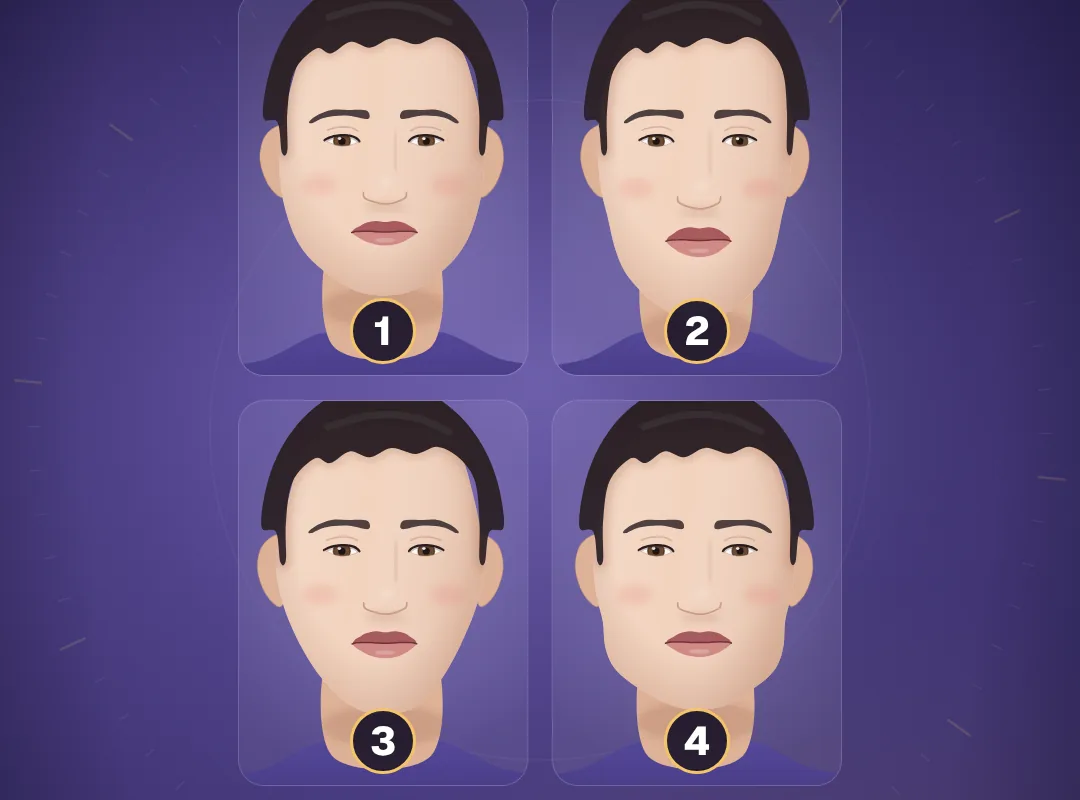
The right beard does for your lower face what a good haircut does for the top: it adds length where your face is short, width where it's narrow and angles where it's soft. A round face suits a beard that is longer at the chin and tight on the cheeks; a long face suits fuller sides and a shorter chin; a narrow chin suits a fuller beard. Oval faces can wear almost anything.
One honest note first: no study has tested beard styles by face shape. The face-shape rules below are barbers' logic of proportion, and you can check that logic with simple arithmetic (worked example below). What research has tested is how beards in general change the way a face is judged, and that's worth knowing before you pick a style.
What studies say about beards
- Stubble often rates best. In a study by Barnaby Dixson and Robert Brooks (Evolution and Human Behavior, 2013), women rated heavy stubble as the most attractive level of facial hair, and full beards highest for how good a father the man would be.
- Beards change how old and dominant you look. Dixson and Paul Vasey (Behavioral Ecology, 2012) found that beards made men look older, higher in status and more aggressive, but not more attractive.
- A beard softens extreme face shapes. In a study of more than 8,500 women (Dixson and colleagues, Journal of Evolutionary Biology, 2016), very masculine and very feminine clean-shaven faces lost attractiveness, and stubble and beards reduced that penalty. Facial hair helped ratings for long-term relationships, not for short-term ones.
- Rare looks better. Janif, Brooks and Dixson (Biology Letters, 2014) showed people faces in sets where beards were either common or rare. Beards were rated more attractive when they were rare, and clean-shaven faces more attractive when they were rare. So the "best" beard partly depends on what everyone around you is wearing.
Below is a quick table, a section for each face shape and the grooming basics (neckline, cheek line and patchiness) that make any beard look intentional.
Find your face shape first
Your face shape comes from your face length compared to its width and which part is widest — forehead, cheekbones or jaw. If you're not sure, follow our guide on how to find your face shape or upload a straight-on selfie to the free face shape detector. Shave or trim short before measuring if you already have a full beard — it hides your real jawline.
Quick reference: beard styles by face shape
| Face shape | Goal | Beards to try | Usually skip |
|---|---|---|---|
| Oval | Keep the balance | Short boxed beard, light or heavy stubble, short full beard | Very long beards that stretch the face |
| Round | Add length and angles | Angular beard longer at the chin, goatee, anchor, short boxed with squared edges | Full, round beards with bulky cheeks |
| Square | Follow or soften the jaw | Stubble or a short beard that traces the jaw; a longer beard rounded at the chin to soften | Very boxy, sharp-cornered beards that add width |
| Heart | Add weight to a narrow chin | Full beard, especially around the chin; short full beard | Thin chin-only beards and very short stubble on the chin |
| Diamond | Add width at the jaw | Fuller beard along the jaw and chin, full stubble | Pointed goatees that narrow the chin further |
| Oblong | Add width, avoid length | Fuller on the cheeks and sides, kept short at the chin; mutton chops; heavy stubble | Long goatees and long chin-heavy beards |
Worked example: how a beard changes your proportions
The free face shape detector measures your face's length (from the top of the forehead to the chin) against its width at the cheekbones. It calls a face round when the length is at most 1.2 times the width and oblong when it's at least 1.42 times. Here is what a beard does to that ratio on paper, using made-up but realistic measurements:
| Face | Length × width | Ratio | With the beard | New outline | New ratio |
|---|---|---|---|---|---|
| Round | 18 × 15.5 cm | 1.16 (round) | 1.5 cm longer at the chin, tight cheeks | 19.5 × 15.5 cm | 1.26 (no longer in the round range) |
| Oblong | 22 × 15 cm | 1.47 (oblong) | 0.5 cm fuller on each cheek, short chin | 22 × 16 cm | 1.38 (below the oblong line) |
| Oblong, wrong beard | 22 × 15 cm | 1.47 (oblong) | 2 cm longer at the chin | 24 × 15 cm | 1.60 (even longer) |
That's the whole logic behind "longer at the chin for a round face, fuller at the sides for a long face". The detector itself measures your face, not your beard, so measure clean-shaven or with short stubble to find your real shape first.
Oval face
An oval face is slightly longer than it is wide with a softly rounded chin, so the beard's job is simply not to throw off that balance.
Try: a short boxed beard, light or heavy stubble or a neatly kept short full beard.
Skip: very long beards, which make an already balanced face look long. More in the oval face guide.
Round face
A round face is about as wide as it is long, with full cheeks and a soft jaw. A beard can add the length and angles the face lacks.
Try: an angular beard that is longer at the chin and shorter on the cheeks, a goatee or anchor style, or a short boxed beard with squared-off edges. Keep the cheek line clean and slightly lower.
Skip: a full beard with lots of volume on the cheeks, which makes the face look wider and rounder. See the round face guide.
Square face
A square face already has a strong, angular jaw. You can either show it off or soften it.
Try: stubble or a short beard that follows the jawline closely to emphasize it; or a longer beard rounded at the chin to soften strong corners.
Skip: very boxy beards with sharp corners at the jaw, which add even more width. Details in the square face guide.
Heart-shaped face
A heart-shaped face is widest at the forehead and cheekbones and narrows to a smaller chin. A beard is one of the best ways to balance it.
Try: a full beard — especially fuller around the chin — or a short full beard that adds weight to the lower face.
Skip: thin, chin-only styles that draw attention to a narrow chin. More in the heart face guide.
Diamond face
A diamond face is widest at the cheekbones with a narrow forehead and jaw. The beard should add width lower down.
Try: a fuller beard along the jaw and chin, or full, even stubble.
Skip: pointed goatees that make the chin look narrower. See the diamond face guide.
Oblong face
An oblong face is noticeably longer than it is wide. The beard should add width at the sides and avoid adding length at the chin.
Try: a beard kept fuller on the cheeks and sides and shorter at the chin, mutton chops or heavy stubble.
Skip: long goatees and long, chin-heavy beards, which make the face look even longer. Details in the oblong face guide.
Grooming basics that make any beard look better
The neckline
The most common beard mistake is a neckline that's too high or too low. A simple guide: place two fingers above your Adam's apple — the neckline usually sits around there. Shave everything below it and trim in a gentle curve from ear to ear. A neckline that sits right on the jaw makes the face look heavier; one that's too low looks unkempt.
The cheek line
Keep it natural. A clean line just below your natural growth looks tidy; a cheek line cut too low makes the beard look thin and the face wider.
Length and shape
- Trim so the beard is slightly shorter on the sides than at the chin — unless you have an oblong face, where the opposite helps.
- Trim with the beard dry; it looks longer when wet.
- Use beard oil or balm to soften the hair and the skin underneath, which reduces itching and flaking.
Patchy or slow growth
- Give it four to eight weeks before judging — many patches fill in with length.
- Heavy stubble or a short boxed beard hides patchiness better than a long full beard.
- Beard thickness is partly genetic: a 2016 genome-wide study of more than 6,000 Latin Americans (Adhikari and colleagues, Nature Communications) found the first gene regions linked to it. If you're thinking about treatments, talk to a dermatologist rather than trying products bought online.
A beard also changes how your jaw reads: a well-shaped one can sharpen a soft jawline, which is covered in our guide on how to get a jawline. For the haircut that pairs with your beard, see best haircuts for men by face shape, and to measure your face shape and proportions, try the free face shape detector.
FAQ
Which beard style suits my face shape?
Match the beard to your goal: longer at the chin for a round face, fuller on the sides and shorter at the chin for a long face, fuller at the chin for a heart or diamond face, and short and tidy for an oval face. These are proportion rules from barbering, not tested in studies; in research, heavy stubble was the most attractive level overall.
What beard is best for a round face?
An angular beard that's longer at the chin and shorter on the cheeks adds length and definition. A goatee, anchor or short boxed beard with squared edges also works.
What beard suits a long face?
Keep the beard fuller on the cheeks and sides and short at the chin to add width without adding length. Avoid long goatees.
Does a beard make your jawline look stronger?
It can change how the jaw reads: a beard trimmed to a clean line along or just below the jaw and slightly fuller at the chin hides a soft edge and adds outline. In studies, beards also made men look older, more dominant and more masculine, but not reliably more attractive; heavy stubble often rated best.
Where should my beard neckline be?
For most people, about two finger-widths above the Adam's apple, trimmed in a gentle curve from ear to ear. Shave everything below that line.
Sources
- Dixson BJ, Brooks RC (2013). The role of facial hair in women's perceptions of men's attractiveness, health, masculinity and parenting abilities. Evolution and Human Behavior 34:236–241.
- Dixson BJ, Vasey PL (2012). Beards augment perceptions of men's age, social status, and aggressiveness, but not attractiveness. Behavioral Ecology 23(3):481–490.
- Dixson BJW, Sulikowski D, Gouda-Vossos A, Rantala MJ, Brooks RC (2016). The masculinity paradox: facial masculinity and beardedness interact to determine women's ratings of men's facial attractiveness. Journal of Evolutionary Biology 29:2311–2320.
- Janif ZJ, Brooks RC, Dixson BJ (2014). Negative frequency-dependent preferences and variation in male facial hair. Biology Letters 10(4):20130958.
- Adhikari K, et al. (2016). A genome-wide association scan in admixed Latin Americans identifies loci influencing facial and scalp hair features. Nature Communications 7:10815.