How to Find Your Face Shape: 6 Shapes + Best Hairstyles
A simple guide to finding your face shape — oval, round, square, heart, diamond or oblong — with measuring steps and the most flattering haircuts for every shape.
By the Aesthetica Team6 min read
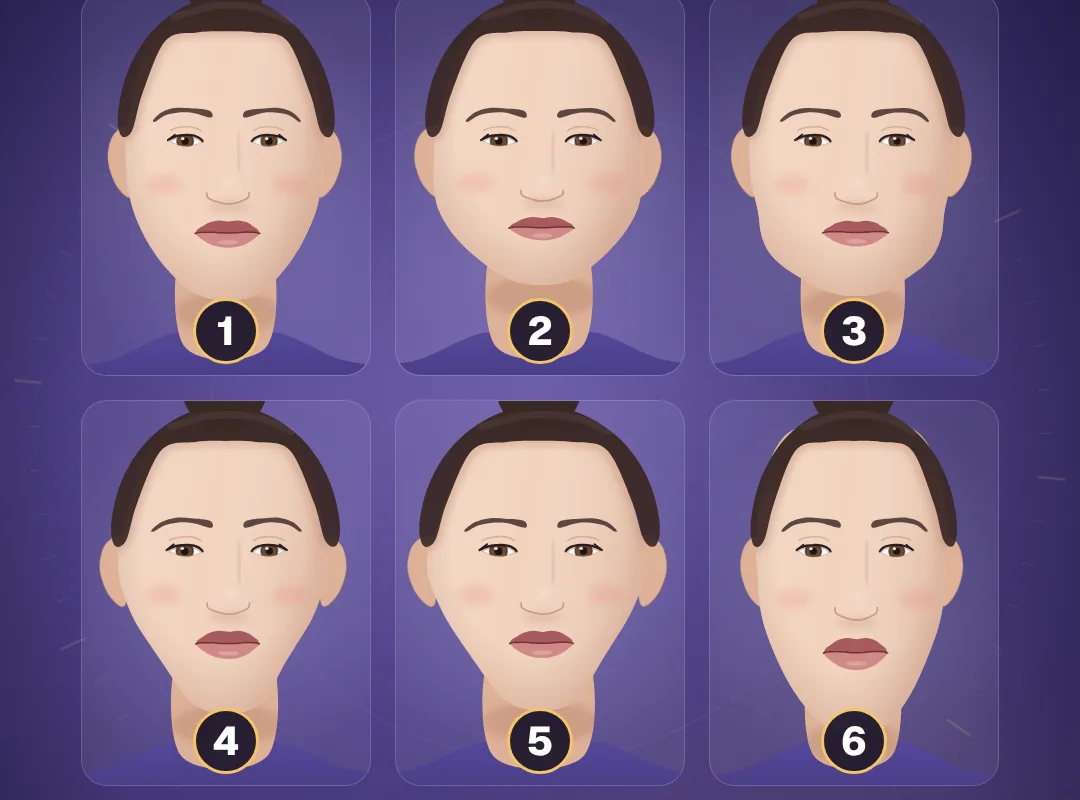
To find your face shape, compare three widths (forehead, cheekbones, jaw) with your face length, and note whether your jaw is angular or rounded. A face that's much longer than wide is oblong; widest at the cheekbones with a narrow forehead and jaw is diamond; wide at the forehead with a narrow jaw is heart; a wide, angular jaw is square; about as long as wide is round; anything balanced in between is oval.
One honest note first: face shapes are a styling convention used by hairdressers and opticians, not a scientific classification, and there's no reliable count of how common each one is. Below are three ways to find yours, the exact rules our free detector uses (so you can check them yourself), and what to do with the answer.
The 6 face shapes
| Face shape | Key features |
|---|---|
| Oval | Longer than wide, forehead slightly wider than jaw, softly rounded chin |
| Round | Length and width about equal, full cheeks, soft jawline |
| Square | Forehead, cheekbones and jaw similar width, strong angular jaw |
| Heart | Wide forehead and cheekbones, narrow pointed chin |
| Diamond | Widest at cheekbones, narrow forehead and jaw |
| Oblong | Noticeably longer than wide, straight sides |
Many faces sit between two shapes. That's normal: the categories are lines drawn across a continuous range.
How to find your face shape: 3 methods
Method 1: Measure it
Pull your hair back and use a soft measuring tape (or a front-facing photo and a ruler):
- Forehead: across the widest part, midway between brows and hairline.
- Cheekbones: across the widest point, just below the outer corners of the eyes.
- Jawline: from the tip of the chin to below the ear, then double it.
- Face length: from the center of the hairline to the tip of the chin.
Then compare: Is the length clearly bigger than the widths? Which of the three widths is largest? Is your jaw angular or rounded? To turn the measurements into a shape, use the rules in the next section.
Method 2: The mirror trace
Stand in front of a mirror and trace the outline of your face with a washable marker or lipstick. Step back and compare the outline with the table above. It's quick, but lighting and angle make it imprecise.
Method 3: Use a face shape detector
The free face shape detector finds about 470 points on your face in your browser and measures the same four distances from them, then links you to the guide for your shape. It gives one label per photo, so if you sit near a line between two shapes, see the note on borderline results below.
The exact rules our detector uses
Most face shape guides describe shapes in words. Here are the actual numbers our detector checks, in this order (the first rule that matches wins). Width means the width at the cheekbones; the jaw angle is the angle at the corner of the jaw.
| Order | Shape | Rule |
|---|---|---|
| 1 | Oblong | Face length ≥ 1.42 × width |
| 2 | Heart | Forehead ≥ 0.86 × width and jaw ≤ 0.74 × width |
| 3 | Diamond | Forehead ≤ 0.78 × width and jaw ≤ 0.76 × width |
| 4 | Square | Jaw ≥ 0.82 × width and jaw angle ≤ 138° |
| 5 | Round | Face length ≤ 1.2 × width |
| 6 | Oval | None of the above |
These thresholds are our own rules, chosen to match how stylists describe the shapes, not population averages. Two practical notes:
- The detector measures length from the top of the forehead, not your hairline, so a tape measurement to the hairline gives a slightly longer face and a higher ratio. Use the rules as a guide for tape measurements, not to the second decimal.
- Borderline results flip. If one of your ratios sits within a few hundredths of a line, a slightly different angle or expression can move you across it. Take three straight-on photos; if they don't agree, you're genuinely between those two shapes, and advice for both applies.
Worked example. Say your tape measurements are: face length 19 cm, cheekbones 14 cm, forehead 12.5 cm, jaw 11.5 cm.
- Length ÷ width = 19 ÷ 14 = 1.36: not oblong (below 1.42), not round (above 1.2).
- Forehead ÷ width = 12.5 ÷ 14 = 0.89, jaw ÷ width = 11.5 ÷ 14 = 0.82: not heart (jaw too wide), not diamond (forehead too wide).
- Jaw is 0.82 × width, right on the square line, so it depends on the jaw angle: an angular jaw (138° or less) makes it square, a rounder one oval. This person sits on the oval–square border.
Best hairstyles for each face shape
These are styling conventions, not tested rules, but hairstyle choice does change how a face is judged: in a study by Mesko and Bereczkei (Human Nature, 2004), the same women's faces were rated differently depending on the hairstyle, and Mannes (2012) found that men with shaved heads were seen as more dominant.
Oval face
The most versatile shape — almost everything works. Try textured crops, quiffs, side parts, long layers, curtain bangs or a sleek bob. Avoid heavy fringes that hide your balanced proportions.
Round face
Aim to add height and angles. Men: pompadours, quiffs and faux hawks with short sides; an angular beard adds definition. Women: long layers, side parts, and asymmetrical lobs. Avoid chin-length rounded bobs and very full sides.
Square face
Soften the strong jaw or lean into it. Men: textured crops, side parts and slightly longer tops; buzz cuts work well with a strong jaw. Women: soft waves, side-swept bangs and layers around the jaw.
Heart face
Balance a wider forehead with fullness at the jaw. Men: medium-length textured styles and fuller beards. Women: chin-length bobs, side-swept bangs and waves that start around the cheekbones.
Diamond face
Add width at the forehead and chin. Men: fringes and textured tops; a fuller beard. Women: deep side parts, curtain bangs and chin-length cuts.
Oblong face
Avoid adding more length. Men: keep the top moderate and the sides slightly fuller; fringes work well. Women: bangs, shoulder-length cuts and volume at the sides.
Glasses for your face shape
A good rule of thumb: choose frames that contrast your face shape. Angular frames suit round faces, round frames soften square faces, and wide frames balance longer faces.
FAQ
What is the most common face shape?
There's no reliable data: face shapes aren't a scientific classification, and studies don't count them. Many people sit between two shapes, which is normal.
What is the most attractive face shape?
Research doesn't rank face shape categories. The closest finding is that faces near the average of their population are rated attractive (Langlois and Roggman, Psychological Science, 1990), and oval is the category for faces with no extreme ratio. But every shape can look great with the right styling, and the golden ratio doesn't hold up as a beauty rule: see golden ratio face.
Can your face shape change?
Partly. Weight changes how full the face is, and facial fat affects how faces are judged (Coetzee and colleagues, Perception, 2009). With age, the facial bones themselves slowly remodel: a 2012 review by Mendelson and Wong describes the eye sockets enlarging and the jawline losing bone. So the same face can measure as a different shape after a big weight change or across decades.
How do I find my face shape from a photo?
Use a straight-on photo at eye level from about 1.5 m, with your hair pulled back and a neutral face, then compare the widths of your forehead, cheekbones and jaw with your face length using the rules above, or upload it to the free face shape detector. Take three photos to check that the result is stable.
Sources
- Langlois JH, Roggman LA (1990). Attractive faces are only average. Psychological Science 1(2):115–121.
- Mesko N, Bereczkei T (2004). Hairstyle as an adaptive means of displaying phenotypic quality. Human Nature 15(3):251–270.
- Mannes AE (2012). Shorn scalps and perceptions of male dominance. Social Psychological and Personality Science.
- Coetzee V, Perrett DI, Stephen ID (2009). Facial adiposity: a cue to health?. Perception 38(11):1700–1711.
- Mendelson B, Wong CH (2012). Changes in the facial skeleton with aging: implications and clinical applications in facial rejuvenation. Aesthetic Plastic Surgery 36.