How to Take the Perfect Selfie for an Accurate AI Face Rating
How to take a selfie that gives an accurate, repeatable AI face rating: distance (with the math), light, head position and expression, plus what research says about why scores move.
By the Aesthetica Team4 min read
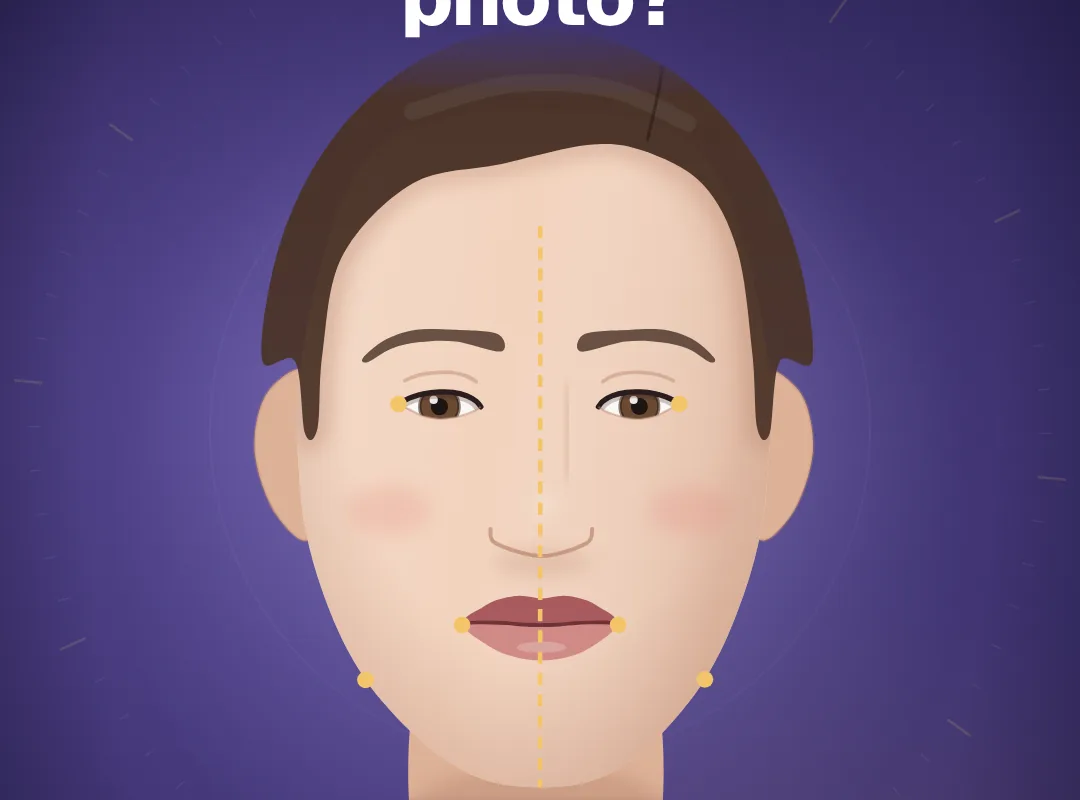
For an accurate AI face rating, put your phone at eye level about 1.5 m (5 ft) away, use a little zoom and a timer, face a window in daylight, keep your head straight and your face neutral, pull your hair off your forehead and skip filters. Then take three photos and compare. The same person can score noticeably differently on two photos taken minutes apart, and most of that difference comes from the camera, not the face.
Why one photo isn't enough
Photos of the same face vary far more than people expect. In a 2011 study in Cognition, Jenkins and colleagues collected everyday photos of the same people and had them rated: attractiveness ratings of different photos of the same person varied more than ratings of different people. An AI rater sees exactly what the camera captured, so it's affected by the same thing. A consistent setup is how you make scores comparable.
1. Step back, then zoom
A camera enlarges whatever is closer to it, and your nose sits a few centimeters in front of your cheeks and ears. In a model by Ward and colleagues (JAMA Facial Plastic Surgery, 2018), a selfie taken from about 30 cm (12 in) made the base of the nose look about 30% wider than a photo from 1.5 m (5 ft).
The math: say your nose tip is about 10 cm in front of your ears (it varies from face to face). How much bigger the nose looks relative to the ears is roughly (distance to the ears) ÷ (distance to the nose):
| Camera distance | Nose enlarged relative to ears |
|---|---|
| 30 cm (a close selfie) | 40 ÷ 30 ≈ 33% |
| 65 cm (arm's length) | 75 ÷ 65 ≈ 15% |
| 1.5 m (shelf + timer) | 160 ÷ 150 ≈ 7% |
Arm's length is acceptable; 1.5 m is better. Prop the phone on a shelf or against a stack of books, use the rear camera if you can, zoom in about 2× and set a 3-second timer.
2. Camera at eye level
A camera below your face enlarges the chin and jaw and shows the underside of the jaw; a camera above it shrinks the lower face. Keep the lens level with your eyes.
3. Soft light from the front
Stand facing a window in daylight. Front light shows your skin evenly and doesn't create shadows that read as asymmetry. Avoid:
- Overhead light, which darkens the eye sockets
- Light from one side, which makes one half of the face look different from the other
- Backlight, which turns your face into a silhouette
- Dim or colored light at night
4. Head straight, not turned or tilted
Even a small tilt raises one eye and one mouth corner in the photo, and a slight turn makes the nearer side look wider, which changes symmetry measurements. Turn on your camera's grid and keep both pupils on one horizontal line. The free AI face analysis checks this for you: it warns you when your head is tilted more than 8° or turned so that your nose sits more than about 6% of your face's width off-center.
5. Neutral face for measuring, smile for sharing
A relaxed, neutral face (mouth closed, eyes naturally open) gives the most consistent measurements, because a smile moves the cheeks, eyes and jaw. That's different from how people judge you: in experiments by Golle and colleagues (Cognition and Emotion, 2014), the same faces were rated more attractive the more they smiled. So measure neutral, but smile in the photos you share.
6. Show your whole face
Pull your hair back from your forehead and ears so the hairline and face outline are visible. Remove glasses, hats and headbands, which cover the landmarks around the eyes and forehead.
7. No filters, a clean lens
Beauty filters smooth skin and move features, so the AI analyzes the filter, not you. Wipe the lens and use the highest quality setting; blur makes landmark detection less accurate.
Quick checklist
- ✅ Phone at eye level, about 1.5 m away, 2× zoom, timer
- ✅ Daylight from a window in front of you
- ✅ Head straight (grid on), neutral expression
- ✅ Hair off the face, no glasses or hat
- ✅ No filter, clean lens
- ✅ Three photos; compare them
FAQ
Why do I get different AI face ratings on different selfies?
Because the AI rates the photo. Distance, angle, light and expression change the measurements, and research shows different photos of the same person vary more than photos of different people. Use the same setup each time.
How far away should I hold the camera?
At least arm's length, and ideally about 1.5 m with zoom. At 30 cm the nose looks about 30% wider than at 1.5 m; at arm's length the distortion is roughly halved.
Should I smile for an AI face rating?
For measuring, no: a neutral face gives the most consistent result. People do rate smiling faces as more attractive, so smile in the photos you share.
Can I use an old photo for face analysis?
Yes, if it's front-facing, sharp and well lit. To track changes, use recent photos taken the same way.
Sources
- Jenkins R, White D, Van Montfort X, Burton AM (2011). Variability in photos of the same face. Cognition 121(3):313–323.
- Ward B, Ward M, Fried O, Paskhover B (2018). Nasal distortion in short-distance photographs: the selfie effect. JAMA Facial Plastic Surgery 20(4):333–335.
- Golle J, Mast FW, Lobmaier JS (2014). Something to smile about: the interrelationship between attractiveness and emotional expression. Cognition and Emotion 28(2):298–310.