Mouth Breathing Face: Can It Really Change Your Face?
Can mouth breathing change your face? In growing kids it is linked to a longer lower face and a set-back jaw. What the studies show, and what adults can do.
By the Aesthetica Team7 min read
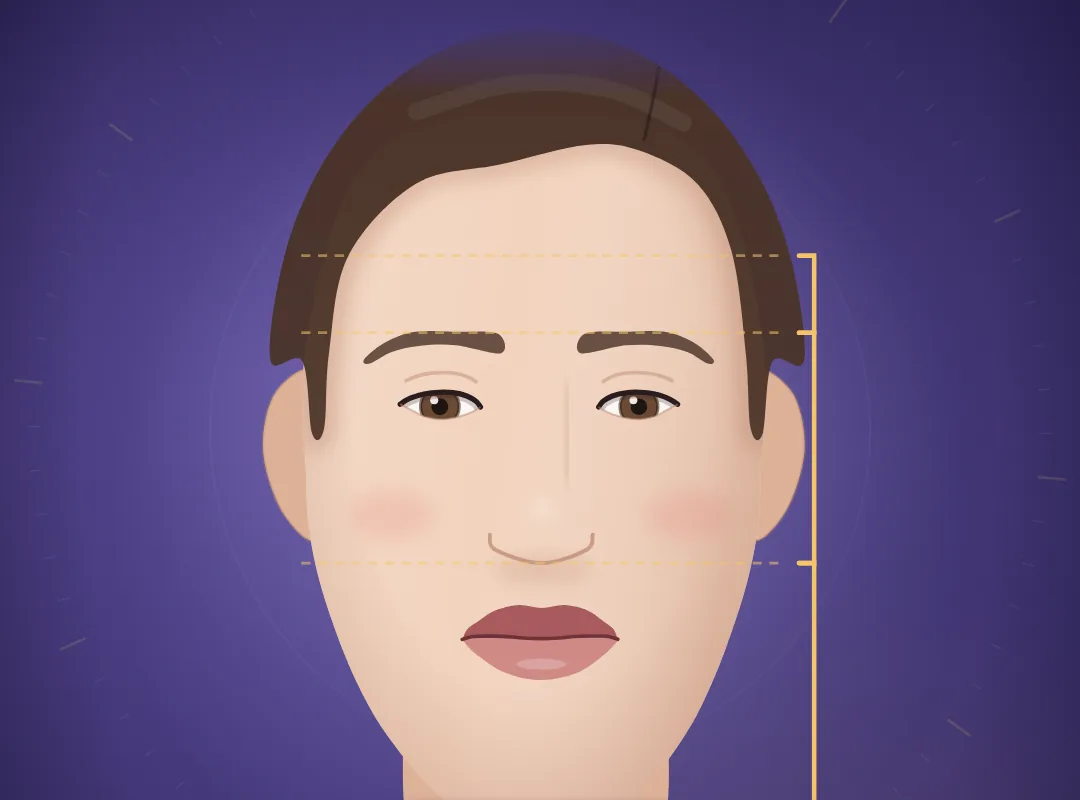
In growing children, yes, it can. Long-term mouth breathing, usually caused by a blocked nose (enlarged adenoids, allergies), is linked to a longer lower face, a lower jaw that sits further back and lips that stay apart at rest — sometimes called “adenoid face” or “long face syndrome”. In adults, there is no good evidence that switching to nose breathing reshapes your bones, so a “mouth breathing face” isn't something you can fix with a breathing trick.
What's worth knowing: if you or your child can't breathe comfortably through the nose, that's a medical question first and a looks question second. Below: the research in order, what it does and doesn't show, and a one-minute check.
The short answer
| Question | What the evidence says |
|---|---|
| Is mouth breathing linked to face shape in children? | Yes: mainly a longer lower face and jaws that rotate down and back |
| Does it cause the changes? | Partly, in growing faces; animal studies and adenoid surgery follow-ups support a causal role |
| Can it change an adult's face? | No good evidence; adult facial bones don't remodel this way |
| What's the usual cause? | A blocked nose: enlarged adenoids or tonsils, allergies, a deviated septum |
| Should I tape my mouth at night? | Not on your own: a 2025 review of 10 studies found little benefit and real risks |
What a “mouth breathing face” looks like
The features described in studies of children who breathe mainly through the mouth:
- A longer lower third of the face (from the base of the nose to the chin).
- A lower jaw that sits further back and is rotated down and back, which makes the jaw angle steeper and the chin less prominent.
- Lips apart at rest, with the tongue resting low in the mouth.
- A narrower upper dental arch, sometimes with a high palate or crossbite.
These are averages across groups, not a checklist for diagnosing anyone. Plenty of long faces have nothing to do with breathing: face shape is partly inherited. In a 2017 genetic study by Cole and colleagues (Genetics), the heritability of individual facial measurements ranged from about 28% to 67%.
The research, in order
1970: children with large adenoids
Swedish orthodontist Sten Linder-Aronson compared children whose noses were blocked by enlarged adenoids with children who breathed normally (Acta Oto-Laryngologica, supplement, 1970). The adenoid group had, on average, a longer face, a steeper lower jaw set further back and narrower upper dental arches.
The more telling part came later. Linder-Aronson, Woodside and Lundström (American Journal of Orthodontics, 1986) followed 38 children aged 7 to 12 for five years after their adenoids were removed. After surgery, their lower jaws tended to grow in a more forward direction than before, partly reversing the backward rotation. That points to breathing as one cause, not just a coincidence.
It wasn't a full reset, though. In a later follow-up (Mahony, Karsten and Linder-Aronson, 2004), the children who had surgery still had a longer lower face than the controls at the end.
1981: the monkey experiment
Egil Harvold and colleagues (American Journal of Orthodontics, 1981) blocked the noses of young rhesus monkeys with silicone plugs, forcing them to breathe through their mouths. The monkeys adapted in different ways, so the changes varied from animal to animal. A 1982 report in the same journal measured the result: compared with eight control monkeys, the eight mouth-breathing monkeys developed a lower chin, a steeper lower jaw and a wider jaw angle. When breathing changed in a growing face, the face changed too.
2021: the meta-analysis
A systematic review and meta-analysis in BMC Oral Health (Zhao and colleagues) pooled 10 studies on children. Compared with nose breathers, mouth-breathing children had both jaws rotated down and back, a lower jaw set about 2 degrees further back on X-rays, a steeper bite plane and upper front teeth that tended to tip forward. The authors still call the effect on facial bones controversial, because most of the studies compared groups at one point in time rather than following children as they grew.
The honest part: what it doesn't mean
- It's about growing faces. All of this evidence comes from children and young animals, whose faces are still growing. Once you're an adult, your facial bones don't remodel because you start breathing through your nose. Before-and-after photos online are almost always explained by head posture, camera angle, lighting or weight change.
- Mouth breathing is usually a symptom. Most children breathe through their mouths because their nose is blocked. Treating the cause matters more than the habit itself.
- Genes matter too. Face shape is partly inherited, and the causal link between breathing and face shape is still debated among orthodontists. A long face is not proof of a breathing problem.
- Trends to skip. Mouth taping is popular online, but a 2025 systematic review in PLOS ONE (Rhee and colleagues) looked closely at 10 studies: only two found a slight benefit, in people with mild sleep apnea. The authors warned that taping could be dangerous for people whose nose is partly blocked, which is exactly why many people breathe through their mouths. Mewing claims to fix adult jaws — see does mewing work for why the evidence isn't there.
What actually helps
For children: constant mouth breathing, snoring, an open mouth at rest or restless sleep is a reason to see a pediatrician, ENT doctor or orthodontist. Enlarged adenoids, allergies and narrow upper jaws can be treated, and the studies above all looked at faces that were still growing. Whether a child needs surgery or orthodontic treatment is a decision for those professionals.
For adults: if breathing through your nose feels hard, an ENT doctor can check for allergies, a deviated septum or polyps. Loud snoring or waking up tired is worth raising with a doctor too. Treating a blocked nose won't reshape your jaw, but it's worth doing for comfort and sleep.
For your looks: the things that change how your lower face reads are posture and photos. Keep your lips gently together and your head upright instead of jutting forward, and see how to get a sharper jawline for what does and doesn't work.
Check yours
- The one-minute check. Sit upright, close your lips gently and breathe through your nose for one minute at a normal pace. This is a simple self-check, not a medical test. If you can't do it comfortably, or you often wake up with a dry mouth, mention it to a doctor.
- Look at your lower third. Take a straight-on photo at eye level from at least arm's length. The free AI face analysis measures the distance from between your brows to the base of your nose (middle third) and from the base of your nose to your chin (lower third) and shows each as a share of the two together. A lower third well above 50% means a longer lower face; it doesn't tell you why. The tool also splits the lower third into upper lip and chin, which helps you see whether the extra length is above or below the mouth. Facial thirds explains how to measure all three thirds by hand.
- Read it calmly. A slightly longer lower third is common and often just how your face is built. An AI face rating or a measurement is a guide, not a diagnosis.
FAQ
Can mouth breathing change your face?
In growing children, long-term mouth breathing is linked to a longer lower face and a lower jaw set further back, and studies of monkeys and of children after adenoid surgery suggest it plays a causal role. In adults, there's no good evidence that breathing changes facial bones.
Can an adult fix a mouth breathing face?
Not by changing how you breathe — adult facial bones don't remodel that way. Jaw position can only be changed with orthodontic or surgical treatment, which is a decision for a qualified professional. Posture, grooming and photo angle change how the lower face looks far more cheaply.
Does mouth taping fix mouth breathing?
There's little good evidence that it does. A 2025 review of 10 studies found a slight benefit in only two, both in mild sleep apnea, and warned of possible harm if your nose is partly blocked. Talk to a doctor before trying it.
How do I know if I'm a mouth breather?
Signs include breathing through your mouth when you're relaxed, lips apart at rest, snoring, and waking up with a dry mouth. If you can't comfortably breathe through your nose for a minute with your lips closed, it's worth getting checked.
Does mewing fix a mouth breathing face?
No controlled study shows that mewing reshapes an adult's face. Resting your lips together and breathing through your nose is a healthy habit, but it won't rebuild your jaw.
Sources
- Linder-Aronson S (1970). Adenoids: their effect on mode of breathing and nasal airflow and their relationship to characteristics of the facial skeleton and the dentition. Acta Oto-Laryngologica Supplementum 265:1–132.
- Linder-Aronson S, Woodside DG, Lundström A (1986). Mandibular growth direction following adenoidectomy. American Journal of Orthodontics (1986).
- Mahony D, Karsten A, Linder-Aronson S (2004). Effects of adenoidectomy and changed mode of breathing on incisor and molar dentoalveolar heights and anterior face heights. Australasian Orthodontic Journal 20(2):93–98.
- Harvold EP, Tomer BS, Vargervik K, Chierici G (1981). Primate experiments on oral respiration. American Journal of Orthodontics 79(4):359–372.
- American Journal of Orthodontics (1982). Primate experiments on mandibular growth direction. American Journal of Orthodontics 82(2):114–119.
- Zhao Z, et al. (2021). Effects of mouth breathing on facial skeletal development in children: a systematic review and meta-analysis. BMC Oral Health 21:108.
- Cole JB, et al. (2017). Human facial shape and size heritability and genetic correlations. Genetics 205(2):967–978.
- Rhee J, Iansavitchene A, Mannala S, Graham ME, Rotenberg B (2025). Breaking social media fads and uncovering the safety and efficacy of mouth taping in patients with mouth breathing, sleep disordered breathing, or obstructive sleep apnea: a systematic review. PLOS ONE 20(5):e0323643.