Face Symmetry and Aging: How Your Face Changes Over Time
How does face aging work? Faces grow slightly less symmetric, bone and fat shift, and the sun can age one side faster. What studies show and what helps.
By the Aesthetica Team8 min read
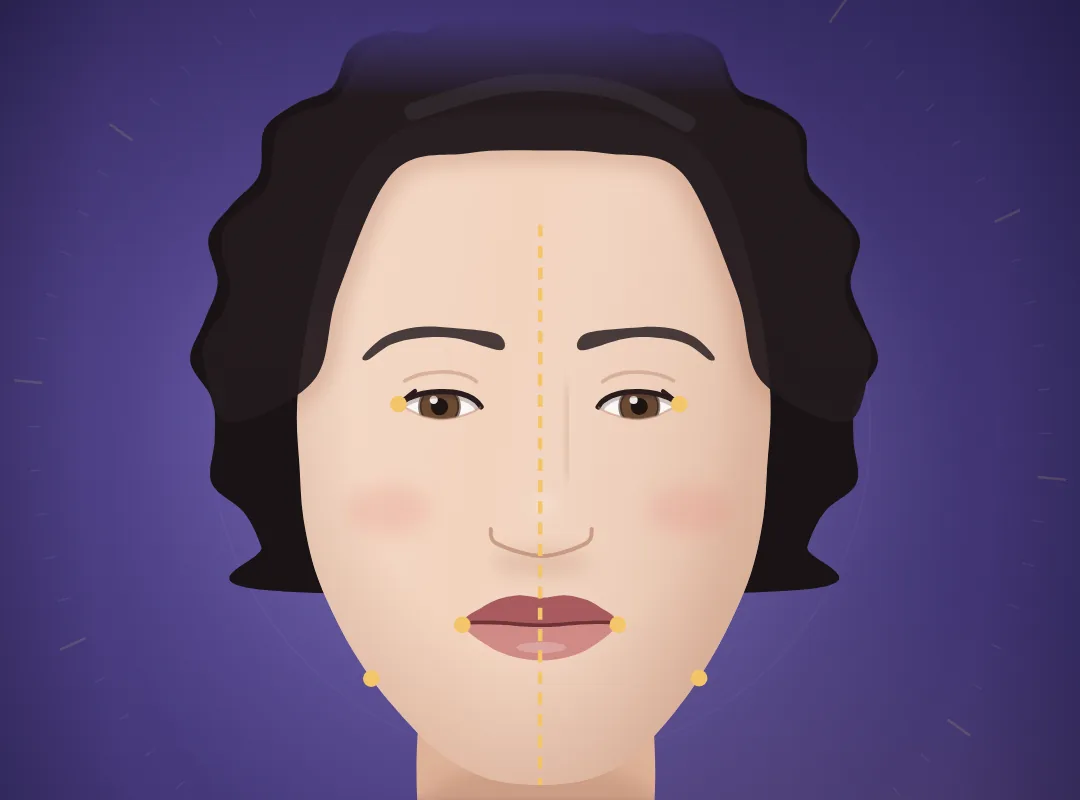
Your face ages in layers, and not always evenly. The skin thins and is marked by years of sun. The fat underneath shrinks and shifts in separate pads. The bones themselves slowly change shape. And symmetry drifts: in a 3D-scan study of people aged 4 months to 88 years, the two halves of the face grew steadily less alike with age, by a fraction of a millimeter per decade.
The good news is that the biggest driver you control is simple: sun exposure. Here's what changes, why one side can age faster than the other, and what actually helps.
The short answer
| Layer | What changes with age | What you notice | What helps |
|---|---|---|---|
| Skin | Sun damage builds up; skin thins and loses elasticity | Spots, uneven tone, fine lines, rough texture | Daily sunscreen, not smoking |
| Fat | Separate fat pads shrink and shift | Hollows under the eyes, flatter cheeks, jowls | Stable weight, no crash diets |
| Bone | Eye sockets widen in places, the upper jaw sets back, the jawline resorbs | A tired look around the eyes, less support for the cheeks and lips | Dental health; for treatments, see a professional |
| Symmetry | The two halves slowly drift apart | One side looks older or more “lived in” | Even sun protection; consistent photos to track it |
Does your face get less symmetrical with age?
Yes, slowly. In a 2018 study in Plastic and Reconstructive Surgery, Linden and colleagues used 3D photography to scan 191 people, from babies of 4 months to adults of 88. They measured how far each face strayed from a perfect mirror image of itself.
- Asymmetry rose steadily with age, with a strong correlation between the two (r = 0.66).
- The change was small. The average face differed from its mirror image by about 0.8 mm, and the study's press release put the increase at about 0.06 mm per decade. You won't see that in the mirror from one year to the next.
- The lower two-thirds changed most, from the eyebrows to the nose and from the nose to the chin.
- It didn't differ by sex or race, and the authors said the cause is still unknown.
So a slightly lopsided face in your 40s or 60s is normal biology, not something you did wrong. For what's within your control at any age, see our guide on how to improve facial symmetry.
Why one side can age faster
Some asymmetry comes from how you live, and the clearest example is a famous photo. In 2012 the New England Journal of Medicine published the case of a 69-year-old man who had driven a delivery truck for 28 years. The left side of his face, the one by the window, was visibly thicker and more wrinkled than the right. His doctors explained why: UVA light passes through window glass, and years of it damage the skin's elastic fibers.
Two everyday versions of the same effect:
- The driver's side. Your window-side cheek gets years of sun the other side doesn't. In the US that's usually the left.
- Your sleeping side. A 2016 review by Anson, Kane and Lambros describes “sleep wrinkles”: lines made by the face being pressed and pulled against the pillow when you sleep on your side or stomach. The authors suggest that years of this may add to visible aging. That part is a hypothesis, not a proven fact, and the first author, plastic surgeon Goesel Anson, co-founded JuveRest, a company that sells a pillow designed against sleep wrinkles.
How your face changes, layer by layer
Skin: the sun does most of the visible damage
In a 2013 study, Flament and colleagues compared 298 women aged 30 to 78 who either sought out the sun or avoided it. Pigment spots and uneven tone were tied mostly to sun exposure, while sagging was tied mostly to age. Wrinkles and texture came from both. The authors estimated that UV exposure “seems to be responsible” for about 80% of visible facial aging signs. Treat that as an estimate: the study was observational and its authors worked for skincare companies.
Fat: it ages in compartments, not as one mass
In 2007, plastic surgeons Rohrich and Pessa injected dye into the faces of cadavers and found that facial fat sits in separate compartments: around the eyes, in three pads over the cheek, along the nose-to-mouth fold and at the jowls. Each compartment changes in volume and position on its own. That's why a face doesn't simply “droop” as a whole. Instead, hollows appear under the eyes and the cheeks flatten while the jowls become more visible.
Bone: the skeleton changes shape
Even the facial skeleton remodels with age. A 2012 review by Mendelson and Wong in Aesthetic Plastic Surgery describes three main changes:
- The eye sockets enlarge in their upper-inner and lower-outer corners, which can make the eyes look more hollow.
- The upper jaw (maxilla) sets back. Its angle is about 10° smaller in people over 60 than in people under 30, so the cheeks and lips have less support.
- The jawline loses bone, especially in front of the jowls, and tooth loss speeds this up in both jaws.
These changes are part of why the same face shape can read differently at 25 and 65.
What speeds face aging up
Identical twins share their genes but not their habits. In a 2009 study, Guyuron and colleagues photographed 186 pairs of identical twins and had a panel guess each twin's age. Then they compared the differences with each twin's habits.
- Smoking: the longer a twin had smoked, the older they looked.
- Sun exposure: more sun went with an older look, and the gap grew with age.
- Weight: a twin with a BMI about 4 points higher tended to look older before 40 but younger after 40. Facial fat fills in the hollows that age creates.
The study shows links rather than proof, but the message is clear: habits you can change show up on your face.
What actually helps
- Wear sunscreen every day, all year. In a randomized trial in Australia (Hughes and colleagues, 2013), 903 adults under 55 were assigned to daily or as-needed sunscreen. After 4.5 years, the daily group had 24% lower odds of measurable skin aging, assessed on the backs of their hands. Our skincare routine shows how to fit it in.
- Protect your window side. If you drive a lot or sit next to a window, sunscreen on both cheeks matters, because UVA passes through glass.
- Don't smoke, or stop. It's one of the clearest factors in the twin research.
- Keep your weight stable. Crash diets take facial fat with them, and after 40 that fat is part of what keeps the face looking full.
- Look after your teeth. Tooth loss speeds up bone loss in the jaws.
- Sleep on your back if it's comfortable. The evidence is weaker here, but it costs nothing.
- For fillers, lasers or surgery, talk to a qualified professional. They can tell you which layer, skin, fat or bone, is actually behind what bothers you.
How to track your face over time
Put the numbers side by side and the problem is clear:
| What changes | How much |
|---|---|
| Age-related asymmetry over 40 years | About 0.24 mm (4 × 0.06 mm), on a face that starts around 0.8 mm off its mirror image |
| The base of the nose in a selfie from 30 cm instead of 1.5 m | About 30% wider (Ward and colleagues, JAMA Facial Plastic Surgery, 2018) |
Decades of aging move a face less than one careless photo does. So any comparison over time only means something if the photos are taken the same way: same window light, camera at eye level, arm's length or farther (1.5 m with a timer is better), neutral expression. Our selfie guide walks through the setup.
A simple way to know whether a change is real:
- Find your noise floor. Take three photos in a row with the same setup and run each through the free AI face analysis. It measures symmetry by mirroring each landmark on one side across your facial midline and comparing it with its partner on the other side, and warns you if your head is turned or tilted. Write down the highest and lowest symmetry score: that spread is how much the score moves when nothing about your face has changed.
- Repeat later with the same setup. Months or years on, take three more photos the same way.
- Only trust a change bigger than the spread. If the new scores fall inside your original range, nothing measurable has changed, whatever the mirror suggests.
The Aesthetica app keeps a history of your scans, which makes the same comparison easier over long periods.
FAQ
Does your face get more asymmetrical as you age?
Yes, but slowly. A 3D-scan study of 191 people aged 4 months to 88 years found that facial asymmetry rose steadily with age, by about 0.06 mm per decade, mostly between the eyebrows and the chin. That's normal, and it's too small to see from year to year.
Why does one side of my face look older?
Often because it gets more sun. UVA passes through car and office windows, so the side facing the window can age faster, as a well-known case of a truck driver showed. Sleeping on one side and photo lighting can add to the difference.
What part of the face ages first?
It varies from person to person. In general, sun-driven changes like spots and uneven tone show early on exposed skin. Bone and fat changes build up over decades and show as hollowing around the eyes, flatter cheeks and jowls.
Can you slow down face aging?
You can slow the parts you control. Daily sunscreen reduced measurable skin aging in a randomized trial, and not smoking and avoiding sun are linked to looking younger in a study of identical twins. Bone and fat changes are part of normal aging; for treatments, talk to a qualified professional.
Does sleeping on your side cause wrinkles?
It can cause “sleep wrinkles”, creases made by the face being pressed into the pillow. A 2016 review suggests that years of this may add to visible aging, but that hasn't been proven. Sleeping on your back avoids the pressure if you find it comfortable.
Sources
- Linden OE, et al. (2018). The relationship between age and facial asymmetry. Plastic and Reconstructive Surgery 142(5):1145–1152.
- Gordon JRS, Brieva JC (2012). Unilateral dermatoheliosis. New England Journal of Medicine.
- Anson G, Kane MAC, Lambros V (2016). Sleep wrinkles: facial aging and facial distortion during sleep. Aesthetic Surgery Journal 36(8):931–940.
- Flament F, et al. (2013). Effect of the sun on visible clinical signs of aging in Caucasian skin. Clinical, Cosmetic and Investigational Dermatology 6.
- Rohrich RJ, Pessa JE (2007). The fat compartments of the face: anatomy and clinical implications for cosmetic surgery. Plastic and Reconstructive Surgery 119(7):2219–2227.
- Mendelson B, Wong CH (2012). Changes in the facial skeleton with aging: implications and clinical applications in facial rejuvenation. Aesthetic Plastic Surgery 36.
- Guyuron B, et al. (2009). Factors contributing to the facial aging of identical twins. Plastic and Reconstructive Surgery 123(4):1321–1331.
- Hughes MCB, Williams GM, Baker P, Green AC (2013). Sunscreen and prevention of skin aging: a randomized trial. Annals of Internal Medicine 158(11):781–790.
- Ward B, Ward M, Fried O, Paskhover B (2018). Nasal distortion in short-distance photographs: the selfie effect. JAMA Facial Plastic Surgery 20(4):333–335.