Baby Face: The Features and Why Some Adults Look Younger
What makes a baby face? Big eyes, high brows, a round face and a small nose and chin. How people judge babyfaced adults, and why some faces look young.
By the Aesthetica Team7 min read
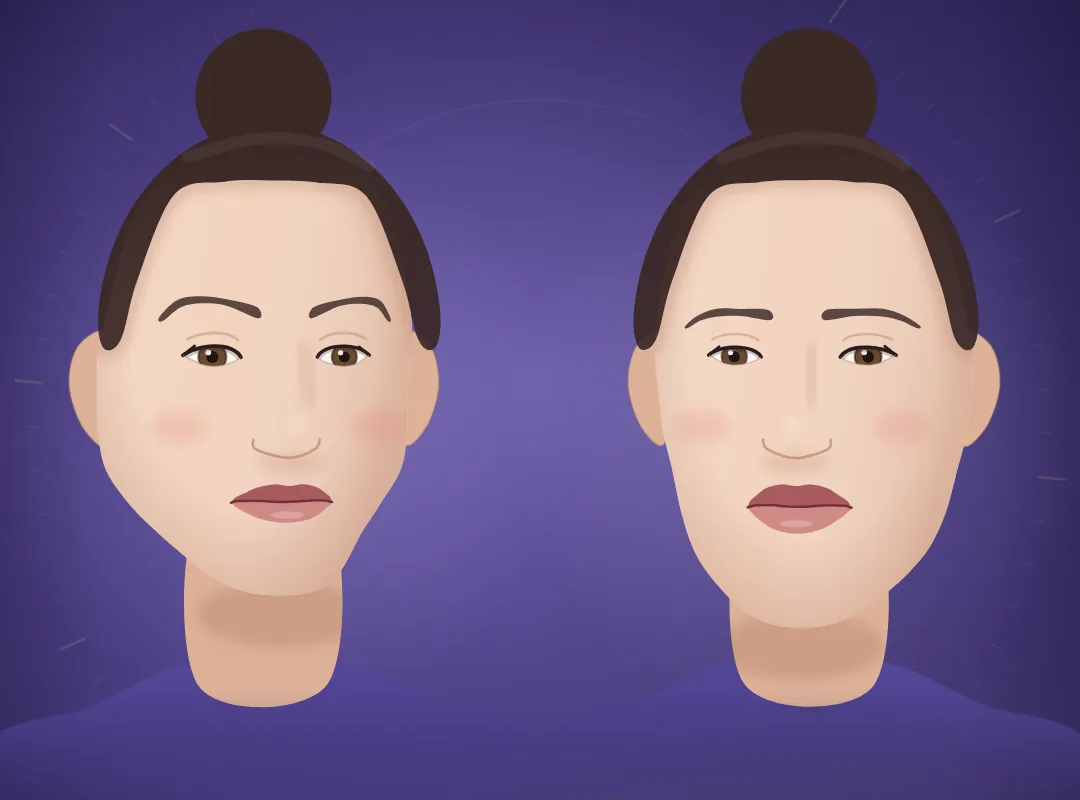
A baby face is an adult face that keeps some of the proportions of an infant's: large eyes for the size of the face, high eyebrows, a round face, full cheeks and a small nose and chin. People read these features in a surprisingly consistent way. In studies, babyfaced adults are judged warmer, more honest and more naive than mature-faced people of the same age, and those snap judgments can follow them into job interviews and even courtrooms.
Looking young for your age is related but not the same thing: it depends more on skin, lips, hair and contrast than on bone structure. Here's what the research says about both.
The short answer
| Question | Answer |
|---|---|
| What is a baby face? | Big eyes, high brows, a round face, full cheeks, a small nose and a small chin |
| How do people judge it? | Warmer, more honest and more naive than a mature face |
| Is it attractive? | For women, babyish features plus a few mature ones score well; for men, results are mixed |
| Why do some adults look younger? | Fewer wrinkles, fuller lips, less gray hair and higher facial contrast |
| Can you change it? | The bone structure is mostly genetic; sun protection and contrast change how young you look |
What makes a face look like a baby's?
In 1943 the zoologist Konrad Lorenz described the Kindchenschema, or baby schema: the set of features that makes babies look babyish and makes adults want to care for them. A large head and forehead, round face, big eyes, a small nose and mouth and plump cheeks.
Adult faces vary on the same features, so some adults simply have more of them. In a classic study, Berry and McArthur (Journal of Personality and Social Psychology, 1985) measured the faces of 20 adult men and had people rate them. The faces rated most babyish had:
- Large, round eyes relative to the face
- High eyebrows
- A small, narrow chin
- A small nose
- A rounder face with fuller cheeks
A baby face is also partly about proportions you can measure. A short lower face, where the space from nose to chin is small compared with the rest, is one reason a face looks young. Our guide to facial thirds explains how to measure it.
How people judge a baby face
The same 1985 study found that babyfaced men were seen as more naive, more honest and warmer than mature-faced men. A later study using the same faces found near-perfect agreement between American and Korean raters on which faces looked babyish, and Korean raters also read childlike traits into them, so this isn't one culture's quirk.
Psychologist Leslie Zebrowitz calls it babyface overgeneralization: our brains are tuned to respond to real babies, and we apply a little of that response to adult faces that resemble them. It's part of the instant judgment people make when they first see a face, explained in our post on first impressions.
These impressions have real effects:
- In court. Zebrowitz and McDonald (Law and Human Behavior, 1991) studied 506 small claims cases. The more babyfaced the defendant, the more likely they were to win cases about harm done on purpose, which the authors linked to what people assume about babyfaced people. In cases about carelessness, the trend went the other way, though that part wasn't statistically significant.
- At work. In a 2009 Psychological Science study, Livingston and Pearce found that Black CEOs looked more babyfaced than White CEOs, and that the more babyfaced Black CEOs ran more prestigious companies and earned more. The pattern didn't appear for White CEOs. The authors argue a baby face can work as a "disarming" signal that counters stereotypes.
Is a baby face attractive?
It depends, and it depends a lot on sex. In a well-known 1986 study, Cunningham measured 24 features in photos of 50 women. Faces with babyish features (large eyes, a small nose, a small chin) were rated more attractive, but the most attractive faces combined them with mature features (prominent cheekbones, narrower cheeks) and expressive ones (high eyebrows, large pupils, a big smile).
For men, the picture is mixed. Some studies find a preference for more masculine faces and others for slightly softer ones; we cover that in facial dimorphism. Overall attractiveness has more to do with balance than any one feature, as our post on what makes a face attractive explains.
Why some adults look younger than their age
A baby face is about structure. Looking young for your age is mostly about how the face has aged. Two studies are especially useful:
- Gunn and colleagues (PLoS ONE, 2009) rated photos of 102 pairs of Danish twins aged 59 to 81 and 162 British women. Wrinkles, gray hair and lip height each predicted how old a woman looked, and sun damage mattered mostly because it adds wrinkles. Women who looked young for their age tended to have fuller lips, less sun damage and genes that protect against graying and wrinkles. How old someone looked was shaped roughly equally by genes and by environment. (The study was funded by Unilever.)
- Porcheron, Mauger and Russell (PLoS ONE, 2013) measured 289 faces of women aged 20 to 70 and found that facial contrast, the difference between the eyes, lips and brows and the surrounding skin, drops with age. When they raised the contrast in photos, the faces looked younger; when they lowered it, older.
One more striking result: in a 2009 BMJ study of 1,826 Danish twins aged 70 and over, people who looked younger than their age in photos tended to live longer, even after adjusting for their real age. The authors see looking young as a marker of how the body is aging, not a cause.
How to check your own face
Take a straight-on photo at eye level, from about arm's length or further with a little zoom, with a neutral expression and your hair pulled back. Then compare:
- Eyes: do they look large for your face?
- Brows: do they sit high above the eyes?
- Lower face: is the space from your nose to your chin short?
- Chin and nose: are they small and soft rather than strong?
- Face shape: is it round, with full cheeks?
The more of these you have, the more babyfaced your face will read. The free AI face analysis measures proportions like your facial thirds from one consistent selfie, the face shape detector tells you whether your face reads as round, and an AI face rating puts it all on a 1–10 scale.
Can you get, or lose, a baby face?
The structure (eye size, nose, chin and jaw) is mostly genetic, and nothing safe will change it after your teens. What you can change is how young your face looks:
- Protect your skin from the sun. Sun damage adds wrinkles and spots, two of the strongest age cues; a daily sunscreen is the core of any skincare routine.
- Keep facial contrast. Well-defined brows and lips raise contrast, which reads younger; makeup does this too.
- Want to look less babyfaced? Shorter hair at the sides, a beard on a weak chin or a slightly lower body fat can make the jaw and cheekbones read stronger.
Surgical and injectable changes to the chin, nose or cheeks carry real risks; talk to a qualified, licensed professional before considering them.
FAQ
What is a baby face?
A baby face is an adult face with infant-like proportions: large eyes for the face, high eyebrows, a round face with full cheeks, and a small nose and chin. People tend to judge babyfaced adults as warmer, more honest and more naive.
What features make a baby face?
The main ones are large, round eyes, high brows, a small nose, a small or narrow chin and a round face with full cheeks. A short lower face, from nose to chin, adds to the effect.
Is having a baby face attractive?
For women, babyish features like large eyes and a small nose are rated attractive, especially combined with high cheekbones and an expressive smile. For men, studies are mixed: some prefer more masculine faces, others slightly softer ones.
Why do some people look younger than their age?
In twin studies, people who look young for their age have fewer wrinkles, fuller lips, less gray hair and less sun damage, influenced about equally by genes and environment. Higher contrast between the eyes, lips and brows and the skin also makes a face look younger.
Do people who look younger live longer?
In a 2009 study of Danish twins aged 70 and over, those who looked younger than their age in photos tended to live longer, even after accounting for their real age. Looking young reflected how they were aging rather than causing it.
Sources
- Berry DS, McArthur LZ (1985). Some components and consequences of a babyface. Journal of Personality and Social Psychology 48(2):312–323.
- McArthur LZ, Berry DS (1987). Cross-cultural agreement in perceptions of babyfaced adults. Journal of Cross-Cultural Psychology 18(2):165–192.
- Zebrowitz LA, McDonald SM (1991). The impact of litigants' baby-facedness and attractiveness on adjudications in small claims courts. Law and Human Behavior 15(6):603–623.
- Livingston RW, Pearce NA (2009). The teddy-bear effect: does having a baby face benefit Black chief executive officers?. Psychological Science 20(10):1229–1236.
- Cunningham MR (1986). Measuring the physical in physical attractiveness: quasi-experiments on the sociobiology of female facial beauty. Journal of Personality and Social Psychology 50(5):925–935.
- Gunn DA, et al. (2009). Why some women look young for their age. PLoS ONE 4(12):e8021.
- Porcheron A, Mauger E, Russell R (2013). Aspects of facial contrast decrease with age and are cues for age perception. PLoS ONE 8(3):e57985.
- Christensen K, et al. (2009). Perceived age as clinically useful biomarker of ageing: cohort study. BMJ 339:b5262.