Weak Chin: Causes, How to Tell and What Actually Helps
What a weak chin is, the two main causes, how to check yours from a side photo, when it can matter for health and which options actually change it.
By the Aesthetica Team8 min read
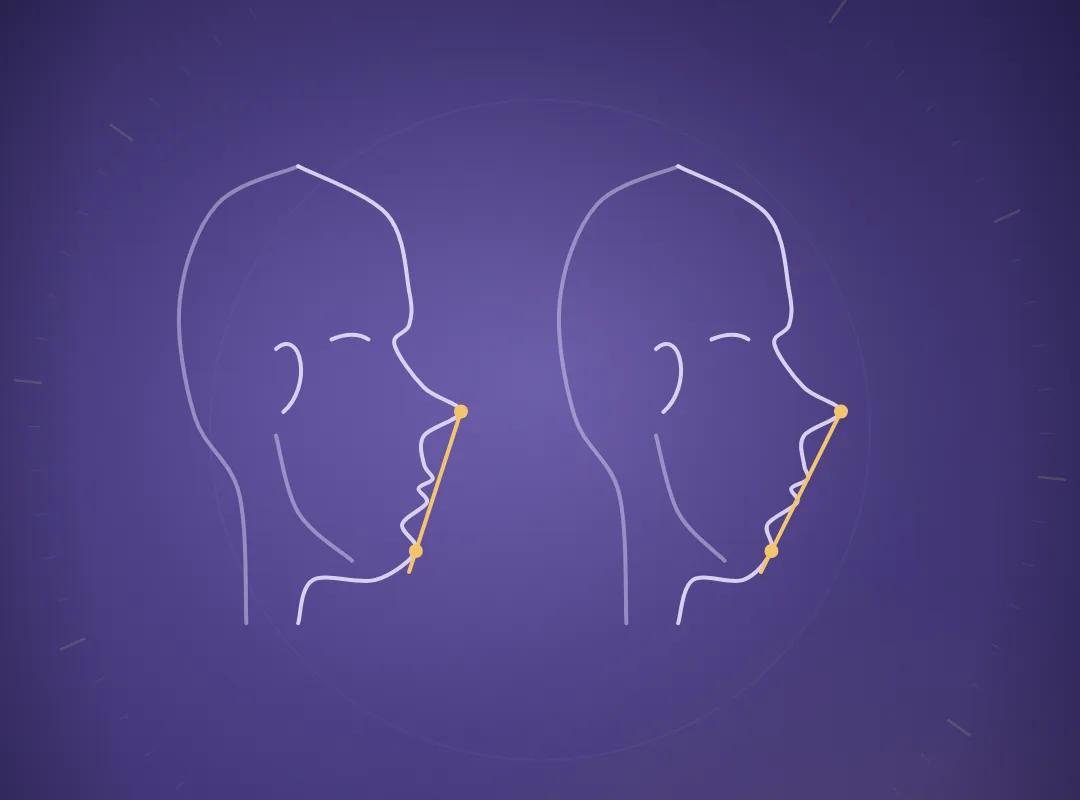
A weak chin (or receding chin) is a chin that sits further back than the rest of the face, so from the side it doesn't line up with the lips and forehead. It isn't a medical diagnosis but a description, and it usually has one of two causes: a small chin bone with a normal bite, or a whole lower jaw that sits back, often with the upper teeth well in front of the lower ones.
Often it isn't the bone at all. Fat under the jaw, a forward head posture or a close phone camera can make an average chin look weak. Here's how to tell the difference and what actually changes it.
The short answer
| Question | Answer |
|---|---|
| What is it? | A chin that sits back from the forehead–lip line when seen from the side |
| Main causes | A small chin bone (normal bite) or a lower jaw that sits back (often a Class II bite) |
| Look-alikes | Fat under the chin, forward head posture, camera angle and distance |
| How to check | A side photo at eye level, then the lines described below |
| What changes it | Fat loss, posture, beard; in teens orthodontics; in adults chin implants, genioplasty, jaw surgery or filler |
| What doesn't | Chin exercises, mewing, “bone smashing” |
The two main causes
1. A small chin bone (microgenia). The jaw and bite are normal, but the bony tip of the chin is small or short, so the chin alone looks set back. This is the classic “just the chin” case.
2. A lower jaw that sits back (retrognathia). The whole lower jaw is small or positioned behind the upper jaw. These people often have a Class II bite: when they bite down, the upper front teeth sit well in front of the lower ones. Here the chin is weak because the whole jaw is.
Surgeons usually check the bite first for exactly this reason. A small chin with a normal bite is a chin problem, while a set-back jaw with a deep overbite is a jaw problem, and the two have different treatments.
Genetics drives most of both. Jaw growth during childhood and the teen years also matters, which is why orthodontists like to see children early.
Things that make a normal chin look weak
- Fat under the chin. It blurs the angle between the jaw and the neck, so the chin seems to melt into the neck. Losing body fat slowly sharpens it; see how to lose face fat.
- Forward head posture. Pushing the head forward, as many of us do at a desk, folds the skin under the chin and shortens the neck line.
- Camera distance and angle. A phone held close to your face enlarges the nose (about 30% wider at 30 cm than at 1.5 m in a model by Ward and colleagues, 2018), so the chin looks smaller next to it. A camera above eye level also makes the chin look smaller. Our post on why you look different in photos explains why.
- The nose and lips. A large nose or full lips can make an average chin look small by comparison.
How to tell if you have a weak chin
Take a side photo at eye level from about 1.5 m away with a little zoom. Stand naturally, look straight ahead at something at eye height and keep your teeth lightly together. Then try two quick checks:
The vertical line (zero meridian). Described by the plastic surgeon Mario González-Ulloa in 1962, it is a line dropped straight down from the deepest point of your nose bridge, between the eyes, with your head level. In an aesthetically balanced profile, the front of the chin sits on or just behind it.
How to measure it: hold a ruler against your cheek for scale, draw the vertical line in a photo editor, and measure the gap to the front of your chin. Say 10 mm on the ruler spans 40 pixels and your chin sits 60 pixels behind the line: that's about 15 mm. There's no single official cut-off: the further behind the line, the more receding the chin. Write the number down and use it to compare photos over time, or to explain what you see to a surgeon or orthodontist.
The E-line. Draw a line from the tip of your nose to the tip of your chin. If your lips sit well in front of it, the chin may be set back, though a large nose or naturally full lips can have the same effect. See our side profile guide for how to read it.
Then check your bite. Bite down gently and look in the mirror from the side. If your upper front teeth sit far in front of your lower teeth, the jaw is probably involved, and an orthodontist or oral surgeon is the right person to assess it.
Remember that these are rough guides from Western clinical practice, not rules. Normal chin and lip positions vary between people and ethnic groups.
Can a weak chin affect your health?
Usually not. A chin that is only small is a cosmetic matter. But a lower jaw that sits well back can narrow the airway behind the tongue, and the clinical reference StatPearls lists a small or set-back lower jaw (micrognathia and retrognathia) among the anatomical risk factors for obstructive sleep apnea. A meta-analysis of cephalometric studies (Neelapu and colleagues, Sleep Medicine Reviews, 2017) found that adults with sleep apnea tend to have a narrower airway, a lower-set hyoid bone and a taller lower face. Many people with a receding jaw sleep fine, though. If you also snore loudly, wake up gasping, or feel very sleepy during the day, see a doctor. A sleep study is the way to find out.
What actually helps
Without any procedure
- Lose body fat slowly to reveal the jaw angle and the chin.
- Fix your posture. Keep your head stacked over your shoulders, at your desk and in photos.
- Grow a beard shaped for it. A beard kept a little longer at the chin and tighter on the cheeks adds visual projection. In a study of more than 8,500 women (Dixson and colleagues, Journal of Evolutionary Biology, 2016), stubble and beards softened the penalty for less typical face shapes. Our guide to beard styles for your face shape has the details.
- Take better photos. Shoot from 1.5 m with zoom, at eye level, with your head level, not tucked in.
In children and teens
When the lower jaw is still growing, orthodontic treatment can correct a Class II bite; how much appliances change the jaw's own growth in the long run is still debated among orthodontists. Timing matters, so it's worth asking an orthodontist early if you notice a large overbite.
In adults
These options change the bone or the soft tissue. All of them have real risks, so talk only to a qualified, licensed surgeon or doctor:
- Chin implant: adds forward projection with a shorter recovery and can usually be removed. It can't change chin length.
- Sliding genioplasty: the surgeon cuts the chin bone and moves it, which can change projection, length and symmetry. It is more involved than an implant.
- Jaw surgery (orthognathic surgery): used when the whole jaw and the bite are the problem, usually together with braces.
- Dermal filler: a temporary, non-surgical way to add some projection, done by a qualified injector.
What doesn't work
Chin exercises, jaw trainers, mewing and “bone smashing” don't change the shape of an adult chin. The last one can cause real injury.
Measuring your face from the front
From the front, the chin sets the length of your lower face, which shows up in measurements like the facial thirds. The free AI face analysis splits your lower third into upper lip (base of the nose to the mouth) and chin (mouth to chin). A common surgeons' guide puts the chin part at about two-thirds; a much smaller share points to a short chin, which is the vertical side of a "weak" chin. It can't measure projection, though: for that, the side-photo checks above are the tool.
FAQ
What causes a weak chin?
Mostly genetics. Either the chin bone itself is small while the bite is normal, or the whole lower jaw sits back, often with the upper teeth well in front of the lower ones. Fat under the chin, posture and camera angle can make an average chin look weak too.
How do I know if my chin is weak?
Take a side photo at eye level with a ruler held against your cheek for scale, and drop a line straight down from the bridge of your nose with your head level. In a balanced profile the chin sits on that line or just behind it; the further back it sits, the more receding it is. Then bite down and check whether your upper teeth sit far in front of your lower teeth.
Can you fix a weak chin without surgery?
You can change how it looks: lose body fat slowly, improve your posture, grow a beard that's longer at the chin and take photos at eye level. Fillers can add some projection temporarily. Exercises and mewing don't change the bone.
Is a chin implant or a genioplasty better?
It depends on the chin. An implant adds forward projection with a simpler recovery, and a genioplasty moves your own bone and can also change length and symmetry. If your bite is off, jaw surgery may be the right option. A qualified surgeon can tell you which fits your case.
Can a weak chin cause sleep apnea?
A small or set-back lower jaw is one of the risk factors for obstructive sleep apnea because it can narrow the airway, but most people with a weak chin don't have it. If you snore loudly, stop breathing in your sleep or feel very sleepy during the day, see a doctor.
Sources
- González-Ulloa M (1962). Quantitative principles in cosmetic surgery of the face (profileplasty). Plastic and Reconstructive Surgery.
- StatPearls (NCBI Bookshelf). Obstructive sleep apnea. National Library of Medicine.
- Neelapu BC, et al. (2017). Craniofacial and upper airway morphology in adult obstructive sleep apnea patients: a systematic review and meta-analysis of cephalometric studies. Sleep Medicine Reviews 31:79–90.
- Ward B, Ward M, Fried O, Paskhover B (2018). Nasal distortion in short-distance photographs: the selfie effect. JAMA Facial Plastic Surgery 20(4):333–335.
- Dixson BJW, Sulikowski D, Gouda-Vossos A, Rantala MJ, Brooks RC (2016). The masculinity paradox: facial masculinity and beardedness interact to determine women's ratings of men's facial attractiveness. Journal of Evolutionary Biology 29:2311–2320.