Side Profile: How to Check Yours and What Makes It Attractive
How to check your side profile at home with the E-line, what straight, convex and concave profiles mean, what research says looks best and what changes it.
By the Aesthetica Team8 min read
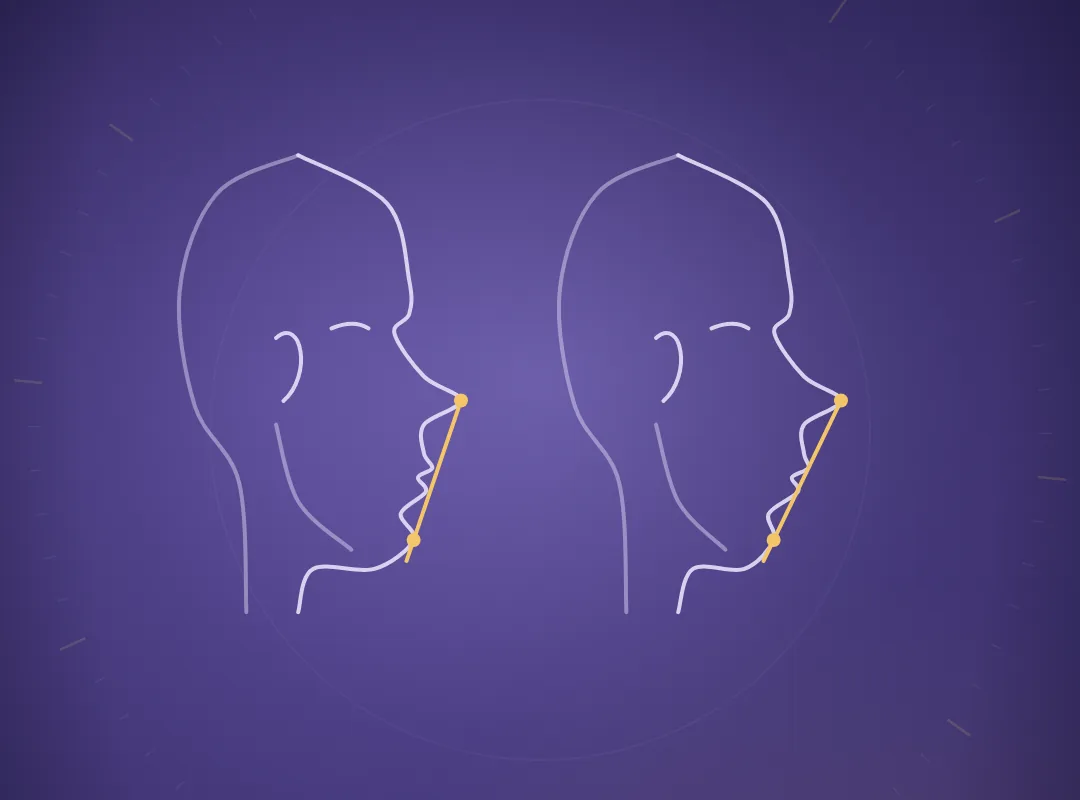
To check your side profile, take a photo from the side at eye level, then draw a straight line from the tip of your nose to the tip of your chin. That's the E-line (esthetic line). In the classic orthodontic guideline, the lips sit just behind it: the lower lip about 2 mm back, the upper lip about 4 mm back. Lips well in front of the line make a profile look fuller and more forward. Lips far behind it, or a chin far behind the nose, make it look flatter.
That guideline is a useful reference, not a pass-or-fail test. It was built on Caucasian adults, normal values differ between populations, and what people find attractive varies with the face and its owner. Here's how to check yours and what each result means.
The short answer
| What you check | Common reference | What it tells you |
|---|---|---|
| E-line (nose tip to chin) | Lower lip ~2 mm behind, upper lip ~4 mm behind | How full your lips sit relative to nose and chin |
| Profile type | Straight or mildly convex is normal | How chin, mid-face and forehead line up |
| Chin position | Roughly under the lower lip when you look straight ahead | Whether the chin projects or recedes |
| Jaw and neck line | A clear angle under the jaw | Mostly body fat, posture and camera angle |
The E-line: the classic profile check
The E-line comes from the American orthodontist Robert Ricketts (American Journal of Orthodontics, 1968). He suggested that in an average Caucasian adult both lips sit slightly behind a line from nose tip to chin: the upper lip about 4 mm back and the lower lip about 2 mm back.
Two things are worth knowing before you measure:
- Ricketts himself acknowledged considerable individual variation. The 2 mm and 4 mm figures are averages from Caucasian samples, not ideals.
- Normal values differ by population. In 70 Japanese adults with normal bites, Nagata (2023) found the lips almost on the line: the upper lip about 0.8 mm behind it and the lower lip about 0.8 mm in front. That's normal for them, not a flaw. A 2025 study in The Angle Orthodontist concluded that Ricketts' norms for the most favorable lip position need updating.
- The line moves with growth. The nose and chin keep growing a lot after about age nine, so lips usually sit further behind the line in adults than in children.
So treat the E-line as a way to describe your profile, not to grade it.
Straight, convex or concave?
Orthodontists sort profiles by how the forehead, the base of the nose and the chin line up. Imagine a line from your forehead to the point just under your nose, and another from there down to your chin.
- Convex. The chin sits back from the forehead–nose line. A mildly convex profile is normal. A strong one usually comes from a chin or lower jaw that sits back, or from a forward upper jaw.
- Straight. Forehead, base of the nose and chin sit roughly in line. This often reads as balanced.
- Concave. The chin sits forward of the line or the mid-face looks flat. This usually comes from a prominent lower jaw or a less projected upper jaw.
None of these is a flaw on its own. They're descriptions, and the same type can look very different depending on nose size, lip fullness and the jaw angle.
What research says looks attractive
Orthodontic researchers test this by showing people a profile edited step by step, with the lips pushed forward or back a few millimeters at a time, and asking them to rate each version.
- People like slightly fuller lips than Ricketts' numbers. In a study by Hier and colleagues (The Angle Orthodontist, 1999), 53 young adults chose their preferred lip position on animated profiles. Both men and women preferred more lip fullness than the E-line values, and women preferred fuller lips than men did.
- Very flat and very full both rate lower. Naini and colleagues (American Journal of Orthodontics and Dentofacial Orthopedics, 2021) moved the lips of male profiles from 16 mm behind the E-line to 4 mm in front of it. Lips far behind the line (12–16 mm) and lips on or in front of it were both rated less attractive.
- The chin matters as much as the lips. The chin is one end of the E-line. A receding chin pulls the line back, so the same lips suddenly sit "in front" of it and look fuller, while a well-projected chin does the opposite. That's why a profile can change a lot with chin position alone; see weak chin.
Profile is also only part of the picture. Most people see you from the front, and front-on features such as facial harmony and proportions shape first impressions more.
How to check your side profile at home
Set up the photo. Have someone take it from about 1.5 m away with a little zoom, the camera at the height of your nose. A close phone photo exaggerates your nose: in a model by Ward and colleagues (JAMA Facial Plastic Surgery, 2018), a photo from 30 cm made the nose base look about 30% wider than one from 1.5 m. Our post on why you look different in photos explains why.
Stand naturally. Look straight ahead at something at eye level, not up or down. Keep your lips relaxed and your teeth lightly together. Tilting your head up makes the chin look stronger, and tucking it in can create a double chin.
Draw the line. In any photo editor, draw a straight line from the tip of your nose to the most forward point of your chin.
Measure the lips. Note whether each lip touches the line, sits in front of it or sits behind it. To turn pixels into millimeters, hold a ruler against your cheek, at the same distance from the camera as your lips.
Worked example: 10 mm on the ruler spans 42 pixels in the photo, so 1 mm ≈ 4.2 pixels. Your lower lip sits 8 pixels behind the line (about 1.9 mm) and your upper lip 15 pixels behind (about 3.6 mm): almost exactly Ricketts' average. If the lower lip were 8 pixels in front of the line instead, you'd read it as about 2 mm in front, which is close to the Japanese norm above.
Check the type. Look at forehead, the base of the nose and chin. Do they line up (straight), does the chin sit back (convex), or does it sit forward (concave)?
The quick ruler test: hold a straight edge, such as a ruler, lightly against the tip of your nose and your chin. If your lips just touch it or sit a little behind it, you're close to the classic E-line. It's rough, but it shows you the idea in seconds.
What actually changes your profile
- Camera and posture. Camera distance, camera height and head tilt can change how your profile looks more than any exercise can. Forward head posture also makes the chin and neck look weaker.
- Body fat. Fat under the chin blurs the jaw and neck angle. Losing body fat slowly sharpens it; see how to lose face fat.
- Grooming. A beard shaped to extend the chin line can visually add projection; see beard styles for your face shape. Hairstyles that add height on top can also balance a strong nose.
- Orthodontics. In teenagers, orthodontic treatment can change lip position and jaw growth. That decision belongs with an orthodontist.
- Procedures. Chin, nose and jaw procedures change profiles in adults. They have real risks, so talk only to a qualified, licensed surgeon.
- What doesn't work: mewing, jaw exercisers and “bone smashing” have no good evidence of reshaping an adult profile, and the last one can cause real injury.
Profile vs. front view
The free AI face analysis on this site works from a straight-on photo and warns you if your head is turned, so it can't measure a profile. From the front it measures proportions and symmetry, including how your lower third splits between upper lip and chin. For the profile itself, the E-line check above is the simplest tool.
FAQ
What is a good side profile?
There isn't one ideal. A commonly used reference is the E-line: lips sitting just behind a line from nose tip to chin. Many people also find a straight or mildly convex profile, with a chin that isn't far behind the lips, balanced. Normal values differ between ethnic groups.
How do I know if my side profile is attractive?
Take a side photo at eye level from about 1.5 m away, draw a line from your nose tip to your chin and see where your lips sit. In rating studies, lips a little behind the line read as balanced, slightly fuller than Ricketts' averages was often preferred, and lips very far behind or well in front rated lower. Remember that people mostly see you from the front and that preferences vary.
What is the E-line?
The E-line, or esthetic line, is a line from the tip of the nose to the tip of the chin, described by the orthodontist Robert Ricketts. In his guideline for adults, the lower lip sits about 2 mm and the upper lip about 4 mm behind it.
Is a convex profile bad?
No. A mildly convex profile is normal. A strongly convex one usually means the chin sits back, which an orthodontist or surgeon can assess if it bothers you or affects your bite.
Can you change your side profile without surgery?
Partly. Camera angle, posture, losing body fat slowly, a well-shaped beard and hairstyle all change how your profile looks. In teenagers, orthodontic treatment can also change it. Exercises like mewing have no good evidence of reshaping adult bone.
Sources
- Ricketts RM (1968). Esthetics, environment, and the law of lip relation. American Journal of Orthodontics 54:271–289.
- Nagata (2023). Lip position relative to the E-line in Japanese adults with normal occlusion. Journal of the Japan Lingual Orthodontic Association.
- The Angle Orthodontist (2025). Study concluding that Ricketts' norms for the most favorable lip position need updating. The Angle Orthodontist.
- Hier LA, Evans CA, BeGole EA, Giddon DB (1999). Comparison of preferences in lip position using computer animated imaging. The Angle Orthodontist 69(3):231–238.
- Naini FB, et al. (2021). Quantitative investigation of the esthetic impact of lip prominence in relation to the esthetic line. American Journal of Orthodontics and Dentofacial Orthopedics.
- Ward B, Ward M, Fried O, Paskhover B (2018). Nasal distortion in short-distance photographs: the selfie effect. JAMA Facial Plastic Surgery 20(4):333–335.