Nose Shapes: The Most Common Types and How They Fit Your Face
The most common nose shapes, from fleshy to Roman and turned-up, what research says about nose width, and how to tell which nose shape you have.
By the Aesthetica Team8 min read
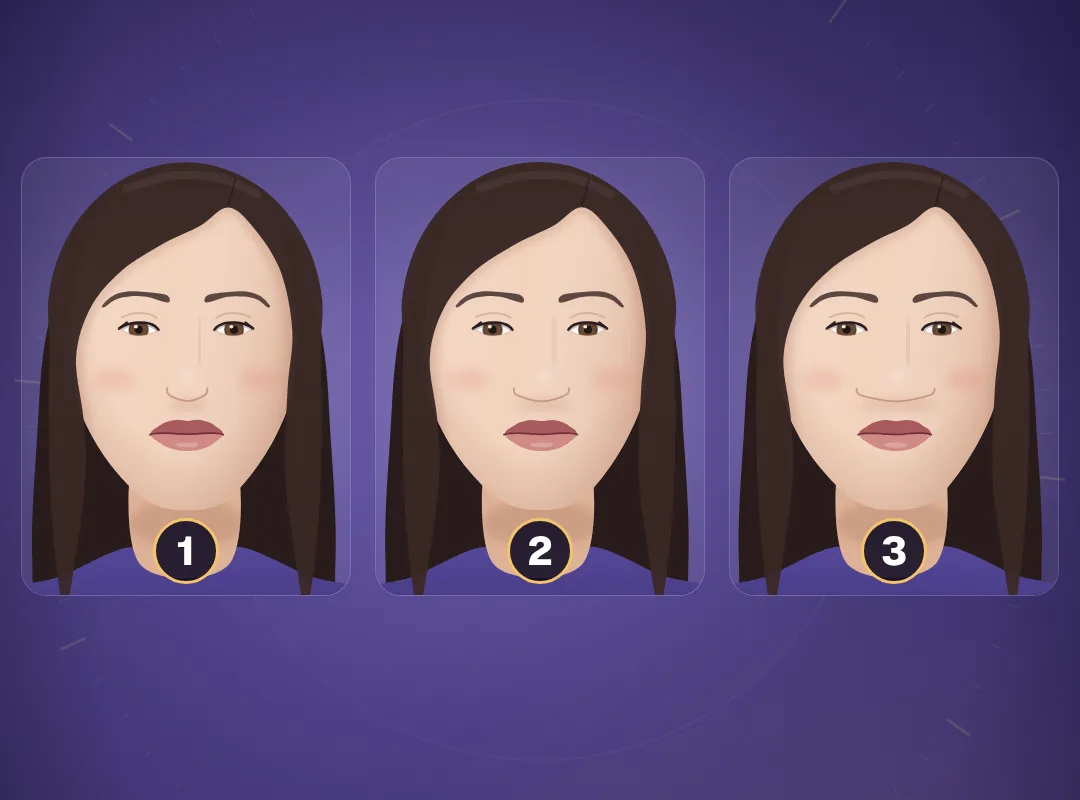
The most common nose shapes are fleshy, straight, Roman, bumpy, turned-up, snub and hawk-like, and most people's noses mix two of them. In one large survey of nose shapes, an Israeli study of 1,793 noses, the fleshy nose came out as the most common type, at about one in four. Shape is only half the story, though: how your nose fits your face depends on its width, its angle to your lip and its line with your chin.
Here's how to tell the types apart, what research says about the "ideal" nose, and how to check yours.
The short answer
| Question | Answer |
|---|---|
| Most common nose shape? | The fleshy nose: 24.2% of 1,793 noses in one survey |
| How many nose types are there? | That survey sorted them into 14 groups; most guides use 6–10 |
| Should your nose be as wide as the gap between your eyes? | That's an old artists' rule, and most real faces break it |
| Why do noses differ? | Ancestry and climate (especially nostril width), plus many genes with small effects |
| Does your nose change with age? | It tends to look longer, partly because the tip droops |
The most common nose shapes
Nose shapes are usually judged from two views: the side (the line of the bridge and the angle of the tip) and the front (how wide the base and nostrils are). These are the types people most often describe:
| Shape | What it looks like | Easiest view to spot it |
|---|---|---|
| Fleshy | A larger, rounded nose with a full, soft tip | Front and side |
| Straight (often called Greek) | A bridge that runs in a straight line from the brow to the tip | Side |
| Roman | A high bridge that curves slightly outward | Side |
| Bumpy | A small hump (a dorsal hump) on the bridge, with an otherwise straight line | Side |
| Turned-up (celestial) | A dip at the middle of the bridge and a tip that points slightly up | Side |
| Snub | A short, small nose with a rounded, slightly upturned tip | Side |
| Hawk (aquiline) | A strongly curved bridge with a tip that points down | Side |
| Wide | A broad base with wide nostrils, from any of the side shapes above | Front |
The numbers come from a 2011 study in the Journal of Craniofacial Surgery by Abraham Tamir, who sorted 1,793 noses from photos and works of art (1,081 of men, 712 of women) into 14 groups. The fleshy nose was the most common at 24.2%; the rarest group showed up in under 1%. In coverage of the study, the turned-up nose was reported as the most common shape in European profile photos (about 22%). Most of the faces were of European origin, so the shares may differ in other populations.
Why noses look so different
Two lines of research explain a lot of the variation.
Climate. A 2017 study in PLoS Genetics (Zaidi and colleagues) measured the noses of people with ancestry from different parts of the world. Nostril width was linked to the temperature and absolute humidity of the regions their ancestors came from: wider nostrils where the air is warm and humid, narrower ones where it's cold and dry. One explanation is that a narrower nose warms and moistens dry, cold air better before it reaches the lungs. The link is a correlation, and the authors note that other forces, such as chance differences between populations, also shaped noses.
Genes. A 2016 study in Nature Communications (Adhikari and colleagues) scanned the DNA of about 6,000 people from Colombia, Peru, Brazil, Chile and Mexico. It found genes linked to nose shape: GLI3 and PAX1 to nostril width, DCHS2 to how pointed the nose is and RUNX2 to the width of the bridge. Each one explains only a small part of the differences between people, which is why noses vary so smoothly rather than falling into neat types.
The “ideal” nose rule most faces break
Renaissance artists left a set of rules for a well-proportioned face, often called the neoclassical canons. One of them says the nose should be as wide as the gap between the eyes (the distance between the inner eye corners).
Modern measurements show this rarely holds:
- A 2015 study in Head & Face Medicine (Al-Sebaei) measured 168 young Saudi dental students who had been chosen for their pleasing faces. The nose was wider than the gap between the eyes in 92% of the men and 56% of the women.
- A 1999 study of 1,050 young Turkish adults in Annals of Plastic Surgery (Borman and colleagues) also found that the nose was wider than the gap between the eyes in most people, and concluded the canons didn't fit most of the population.
So a nose a little wider than your eye gap isn't a flaw. It's the most common way faces are built, even among faces picked as attractive. Men's noses also tend to be wider than women's. The gap between your eyes has its own typical range, covered in our guide to eye spacing.
How your nose fits the rest of your face
A nose doesn't read on its own. Three relationships matter more than the shape label:
- Its share of the face's height. In the classic facial thirds, the middle third runs from the brows to the base of the nose. A longer nose makes the middle third longer.
- Its line with your lips and chin. In profile, the E-line runs from the nose tip to the chin, and the lips usually sit just behind it. A strong nose with a weak chin makes the nose look bigger; a stronger chin balances it. Our guide to the side profile shows how to check it.
- The angle under the tip. The nasolabial angle is the angle between the bottom of the nose and the upper lip. Studies disagree on the ideal: a 2012 survey put it near 96° for men and 98° for women, while a 2014 survey found preferred ranges of about 91–103° for men and 101–109° for women. A slightly more upturned tip tends to be preferred in women.
Your nose changes with age and with your camera
A 2011 study in Forensic Science International (Sforza and colleagues) measured noses across adult ages: older adults had larger nose measurements, and the angle at the tip got smaller, meaning the tip droops. That's part of why noses look longer with age. The study compared different people at different ages, so it shows a pattern across age groups rather than one person's nose over time.
Your camera changes it too. A 2018 model in JAMA Facial Plastic Surgery (Ward and colleagues) found that a selfie taken about 12 inches (30 cm) from the face makes the nasal base look about 30% wider than a photo from 5 feet (1.5 m). If your nose looks big in selfies but not in other photos, the distance is the likely reason; see why you look different in photos.
How to find your nose shape
- Take two photos with the camera at eye level, from about 1.5 m (5 ft) with a little zoom: one straight on, one from the side. Pull your hair back and keep a neutral face.
- Side photo: the bridge. Is it straight, slightly curved outward (Roman), curved strongly (hawk), dipped in the middle (turned-up) or bumped (bumpy)?
- Side photo: the tip. Does it point up, straight ahead or down, and is it rounded and full (fleshy) or defined?
- Front photo: the width. Drop an imaginary line down from each inner eye corner. If your nostrils reach past those lines, your nose is wider than your eye gap, like most people's.
- Look at the whole face. Check the nose's length against your facial thirds and its line with your chin.
The free AI face analysis measures proportions like your facial thirds and symmetry from one consistent selfie, and an AI face rating shows how the whole face comes together on a 1–10 scale. A score is a guide, not a verdict on your nose.
If you're thinking about changing your nose with surgery or fillers, talk to a qualified, licensed professional first; both carry real risks.
FAQ
What is the most common nose shape?
In a 2011 survey of 1,793 noses sorted into 14 groups, the fleshy nose, a larger nose with a full, rounded tip, was the most common at 24.2%. The sample was mostly of European origin, so shares may differ elsewhere.
What nose shape do I have?
Take a side photo at eye level from about 1.5 m. Look at the bridge (straight, curved, dipped or bumped) and the tip (up, straight or down; rounded or defined). Then a front photo shows the width. Many noses mix two types.
What is the ideal nose width?
An old artists' rule says the nose should be as wide as the gap between the inner eye corners, but most real faces break it. In 168 students chosen for their pleasing faces, the nose was wider than the eye gap in 92% of the men and 56% of the women.
Why do noses look bigger in selfies?
A phone held close distorts the face. A 2018 study found that a selfie from about 12 inches makes the nasal base look around 30% wider than a photo from 5 feet.
Does your nose get bigger with age?
Older adults tend to have larger nose measurements, and the tip tends to droop, which makes the nose look longer. These findings come from comparing people of different ages rather than following the same people over time.
Sources
- Tamir A (2011). Numerical survey of the different shapes of the human nose. Journal of Craniofacial Surgery 22(3):1104–1107.
- Zaidi AA, et al. (2017). Investigating the case of human nose shape and climate adaptation. PLoS Genetics 13(3):e1006616.
- Adhikari K, et al. (2016). A genome-wide association scan in admixed Latin Americans identifies loci influencing facial and scalp hair features. Nature Communications 7:10815.
- Al-Sebaei MO (2015). The validity of three neo-classical facial canons in young adults originating from the Arabian Peninsula. Head & Face Medicine 11:4.
- Borman H, Ozgür F, Gürsu G (1999). Evaluation of soft-tissue morphology of the face in 1,050 young adults. Annals of Plastic Surgery 42(3):280–288.
- Sforza C, et al. (2011). Age- and sex-related changes in the normal human external nose. Forensic Science International 204(1–3):205.e1–205.e9.
- Ward B, Ward M, Fried O, Paskhover B (2018). Nasal distortion in short-distance photographs: the selfie effect. JAMA Facial Plastic Surgery 20(4):333–335.
- Armijo BS, Brown M, Guyuron B (2012). Defining the ideal nasolabial angle. Plastic and Reconstructive Surgery 129(3):759–764.
- Sinno HH, Markarian MK, Ibrahim AMS, Lin SJ (2014). The ideal nasolabial angle in rhinoplasty: a preference analysis of the general population. Plastic and Reconstructive Surgery 134(2):201–210.