First Impressions: How Fast Do People Judge Your Face?
People form a first impression of a face in about a tenth of a second. What they judge, why it's often wrong, and how to make a better impression in photos.
By the Aesthetica Team7 min read
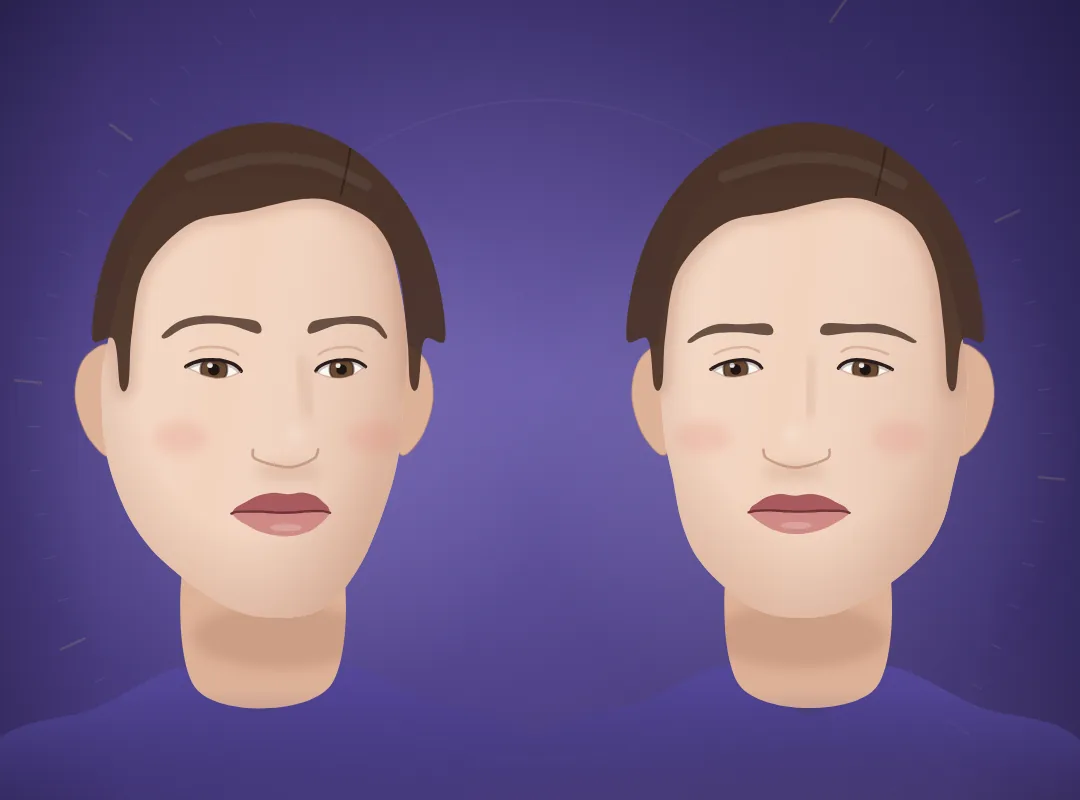
Fast: about a tenth of a second. In a 2006 Princeton study (Willis and Todorov, Psychological Science), people who saw a face for just 100 milliseconds judged it almost the same way as people who could look as long as they liked. Extra time made them more confident, not very different.
But fast isn't the same as accurate. Snap judgments from faces are often wrong, and different photos of the same person can leave very different impressions. That last part is the one you control. Here's what the research shows and how to use it.
The short answer
| Question | What studies show |
|---|---|
| How fast? | About 100 milliseconds is enough to form an impression |
| What do people judge? | Trustworthiness, competence, likeability, aggressiveness and attractiveness |
| Do people agree? | Largely, which is why the same faces get similar snap ratings |
| Are they accurate? | Often not; guessing from a face can be worse than ignoring it |
| Can you change it? | Partly: the photo, the expression and the context all shift the impression |
The 100-millisecond study
In 2006, psychologists Janine Willis and Alexander Todorov showed people photos of unfamiliar faces for 100 milliseconds, 500 milliseconds or one second. Participants rated each face on five traits: attractiveness, likeability, trustworthiness, competence and aggressiveness. Another group rated the same faces with no time limit.
- A tenth of a second was enough. Judgments after 100 ms correlated highly with the untimed judgments for all five traits.
- Trustworthiness was the fastest call. It showed the strongest match between the quick and the untimed ratings.
- More time added confidence, not accuracy. With longer exposures, impressions became more confident and a bit more negative, but they didn't change much.
The authors suggested that later encounters may often just justify the impression people already formed. Wider faces, for example, are quickly read as more dominant. Our post on facial width-to-height ratio covers that research.
What people read from a face
A 2008 study by Nikolaas Oosterhof and Alexander Todorov in PNAS found that most snap judgments boil down to two questions:
- Is this person friendly or a threat? This shows up as trustworthiness. In their face models, making a neutral face look more trustworthy also made it look slightly happier, and making it look less trustworthy made it look angrier.
- How strong are they? This shows up as dominance, tied to features that signal physical strength, such as a more masculine, mature-looking face.
The authors argue these are overgeneralized versions of old survival questions: does this person mean harm, and could they cause it? That explains why the judgments are fast, and also why they're often wrong. A face that happens to look a little like an angry expression isn't a sign of an angry person.
Snap judgments have real effects
These split-second impressions shape real decisions. In a 2005 study in Science, Todorov and colleagues showed people pairs of photos of election candidates they didn't recognize, for about a second, and asked which one looked more competent. The face picked as more competent had won 68.8% of the 2004 US Senate races; across the Senate races of 2000, 2002 and 2004 the figure was 71.6%, and in House races about 67%. Judgments of attractiveness or likeability didn't predict the results; competence did.
The twist: first impressions are often wrong
People agree with each other about faces. That doesn't mean they're right. In 2010, Christopher Olivola and Alexander Todorov (Journal of Experimental Social Psychology) analyzed more than a million judgments from a website where users guessed things about strangers from their photos, plus an online experiment with over a thousand participants. People would usually have been more accurate if they had ignored the face and guessed from how common each trait is in the population. Appearance cues pulled their guesses off course.
In other words, a first impression reliably tells you what most people will think about a face. It is a poor guide to who the person actually is.
The same face, different first impressions
The most useful finding for you comes from a 2014 study by Todorov and Jenny Porter in Psychological Science. Instead of using one photo per person, they used several photos of the same people:
- Different photos of the same person got very different ratings. For a range of social judgments, the variation between photos of one person was as large as, or larger than, the variation between different people, even though all the photos were straight-on headshots in similar light.
- The best photo depended on the context. Participants picked one photo of a person for a dating profile, another for a movie villain and another for a political candidate.
- It happened even at a glance. People's preferences between photos held up even when each photo was flashed for 40 milliseconds.
So the first impression your face makes depends heavily on which picture people see. Lighting, angle, distance and expression all matter. Our post on why you look different in photos explains the camera side of this.
How to make a better first impression in photos
- Take several photos and let someone else choose. In a 2017 study, photos picked by other people made better first impressions than the ones people picked of themselves. More on that in do you look better than you think.
- Pick for the context. A friendly, approachable photo for dating and a confident, competent one for work can be different pictures of the same face.
- Let the expression read as friendly. Trustworthiness judgments track how happy or angry a face looks, so a relaxed face with a slight, natural smile reads warmer than a tense one.
- Fix the camera. Shoot from at least arm's length, at eye level, in soft window light. A close selfie distorts your proportions before anyone has judged your face.
- Remember it's a first impression, not a final one. People update their views as they get to know someone. The photo just decides how that starts.
Run the one-second test on your own photos
The election study used about a one-second look and a simple question: which face looks more competent? You can run the same test on your own photos with friends:
- Pick 4–6 candidate photos, all taken from at least arm's length in soft light.
- Pair them up and put each pair side by side on one screen.
- Show each pair for about a second, then hide it and ask one question that matches the use: "Who looks more trustworthy?" for a dating or profile photo, "Who looks more competent?" for work.
- Ask at least five people, ideally some who don't know you well, and change the left–right order between people.
- Keep the photo that wins most pairs. With five people, a 5–0 split for one photo in a pair is unlikely to be chance (about 6%), while 3–2 means the two photos are about equal; the table in which side of your face is better shows the odds.
This uses what the studies found: impressions form in a second, people largely agree, and the photo changes the impression as much as the face does. An AI face rating or the free AI face analysis judges a photo too, but neither measures trustworthiness or competence, which is what this test asks real people about.
FAQ
How long does it take to form a first impression of a face?
About a tenth of a second. In a 2006 study, impressions formed after seeing a face for 100 milliseconds closely matched impressions formed with unlimited time, especially for trustworthiness. Looking longer mostly made people more confident.
Are first impressions from faces accurate?
Often not. People tend to agree with each other, but in a study of more than a million appearance-based judgments, guesses about strangers were usually less accurate than guesses that ignored the face altogether.
What makes a face look trustworthy?
Research suggests trustworthiness judgments track how happy or angry a face looks, even when it's neutral. Faces that look slightly happier read as more trustworthy, and faces that resemble anger read as less trustworthy.
Can you change the first impression your face makes?
Partly. Different photos of the same person can change ratings as much as the differences between people, so the photo, expression, lighting and camera angle all matter. Letting other people pick your photo, for example with a quick one-second comparison, helps too.
Do people judge your face the same way in every photo?
No. A 2014 study found that different images of the same person led to very different impressions, and people even preferred different photos of the same face depending on whether it was for dating, politics or a movie role.
Sources
- Willis J, Todorov A (2006). First impressions: making up your mind after a 100-ms exposure to a face. Psychological Science 17(7):592–598.
- Oosterhof NN, Todorov A (2008). The functional basis of face evaluation. Proceedings of the National Academy of Sciences 105(32):11087–11092.
- Todorov A, Mandisodza AN, Goren A, Hall CC (2005). Inferences of competence from faces predict election outcomes. Science 308:1623–1626.
- Olivola CY, Todorov A (2010). Fooled by first impressions? Reexamining the diagnostic value of appearance-based inferences. Journal of Experimental Social Psychology 46(2):315–324.
- Todorov A, Porter JM (2014). Misleading first impressions: different for different facial images of the same person. Psychological Science 25(7):1404–1417.
- White D, Sutherland CAM, Burton AL (2017). Choosing face: the curse of self in profile image selection. Cognitive Research: Principles and Implications.