Which Side of Your Face Is Better? The Left-Cheek Effect
Which side of your face is better? Portraits favor the left cheek, and viewers rate it as more pleasant. What studies found, and how to test your own best side.
By the Aesthetica Team7 min read
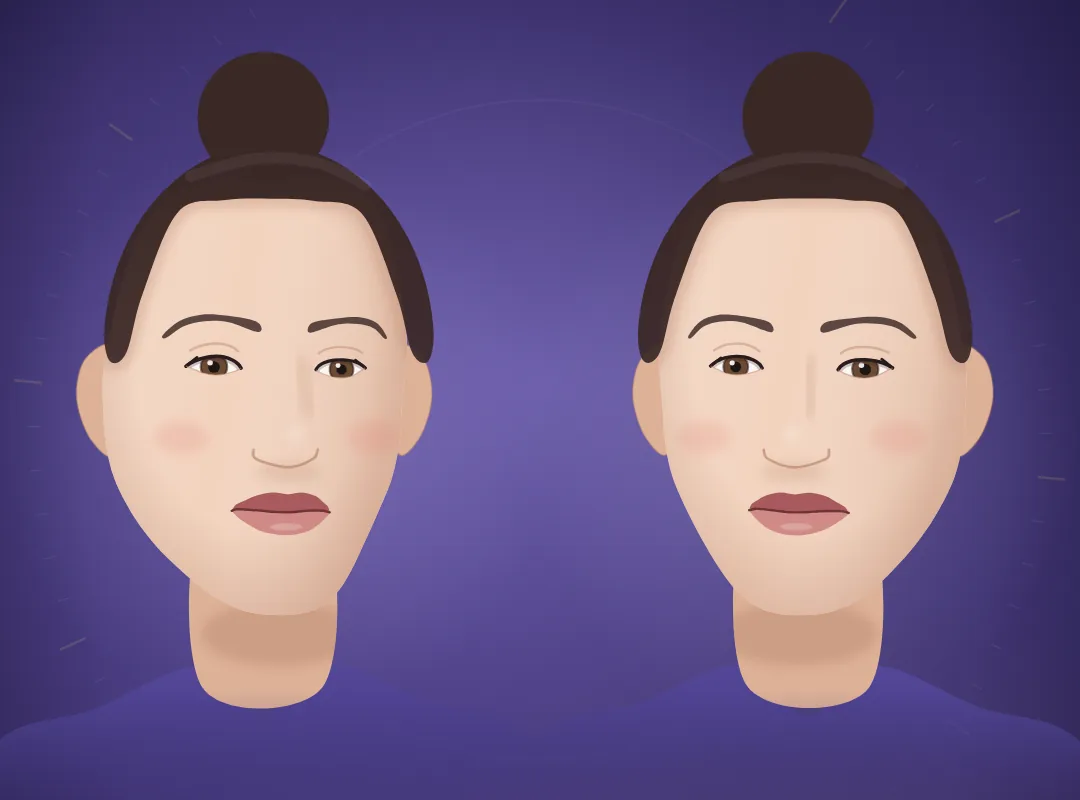
For most people, research points to the left side — the side of your face on your left, which the camera sees when you turn your head slightly to your right. In a classic count of 1,474 painted portraits, about 60% showed more of the left cheek, and in one experiment viewers rated left-cheek photos as more pleasant even when the images were mirror-flipped. The likely reason: the left side of the face tends to show emotion more strongly.
But that's an average across many people. Your own best side depends on your face's own asymmetries, your hair and your light, so the only reliable answer is a quick test. Below: the studies, why the left side might win, and how to find yours in two minutes.
The short answer
| Question | What studies suggest |
|---|---|
| Which side do portraits show? | About 60% show the left cheek, across centuries of Western portraits |
| Which side do viewers prefer? | In a 2012 experiment, left-cheek photos were rated more pleasant, even when mirror-flipped |
| Why the left? | The left side of the face is thought to show emotion more intensely |
| Is everyone's best side the left? | No — it's a tendency; your own asymmetries, hair and light can make your right side better |
| How do I find mine? | Two photos in the same light, one per side, and let at least five people choose blind |
First: what “left cheek” means
Your left cheek is on your left. To show it, you turn your head slightly to your right. In the finished photo, the left cheek is on the viewer's right side. This is easy to mix up, especially in a mirror, which flips everything — more on that in why you look different in photos.
The research, in order
1973: centuries of portraits
Psychologists Chris McManus and Nicholas Humphrey counted 1,474 Western portraits painted over several centuries and published the result in Nature under the title Turning the Left Cheek. About 60% of the sitters showed more of their left cheek, and 40% their right. The bias was stronger in portraits of women (68% left) than of men (56%). Later researchers found the same leftward tendency in many other sets of portraits and photos.
1999: it's the sitter, not the painter
Michael Nicholls and colleagues tested why (Proceedings of the Royal Society B). Their answer: the bias comes from sitters choosing which side to show, depending on how much emotion they want to show.
Two details make the case:
- The Royal Society's collection of portraits of scientists, where the goal is to look serious and rational, showed no cheek bias.
- In an experiment, people asked to pose for a portrait for their family, showing as much emotion as possible, tended to turn their left cheek to the camera; people asked to pose as a scientist and hide their emotions tended to turn their right.
2012: viewers prefer the left cheek
Kelsey Blackburn and James Schirillo (Experimental Brain Research) photographed 10 men and 10 women from both sides, then mirror-flipped the images so every left cheek could also appear as a “right” one. Viewers rated left-cheek photos as more pleasant, whether or not the image was flipped. So the preference followed the actual side of the face, not the direction the head was turned. Viewers' pupils also widened more for the images they rated more pleasant.
Why the left side might look better
The leading explanation is about emotion. The right half of the brain is more involved in processing emotion, and it controls much of the left side of the face. In a well-known test, Sackeim, Gur and Saucy (Science, 1978) split photos of expressions down the middle and built whole faces from two left halves or two right halves: the left-left faces looked more intensely emotional. And a happier-looking face tends to be rated more attractive (Golle, Mast and Lobmaier, 2014).
It's a reasonable explanation, but not a settled one. These were relatively small studies, and the effect is a tendency, not a rule.
The twist: your best side might be your right
Averages don't decide your face. Things that can make your right side the better one:
- Your own asymmetry. Almost every face is a little asymmetric: one eye a bit higher, one brow more arched, one side of the smile lifting more. Your stronger side may simply be your right. See how to improve facial symmetry for what's normal.
- Your hair. A side part, fringe or longer side frames one side of the face better.
- The light. The side closer to a window is lit more evenly; flip the light and the “better side” can flip too.
- Who's judging. People are poor judges of their own photos: in a study by White, Sutherland and Burton (2017), photos that other people picked made better first impressions than the ones people picked of themselves. See do you look better than you think.
How to find your best side
- Set up once. Face a window, camera at eye level and about arm's length away or farther, same expression both times. Our selfie guide covers the setup.
- Take two photos. Turn your head slightly to your right (left cheek to camera), then the same amount to your left (right cheek to camera). Use the same expression both times.
- Don't mirror-flip them. Use the photos as the camera took them.
- Ask at least five people which photo looks more like your best self, without telling them which side is which. Show the photos in a different order to each person.
- Read the vote honestly. With two photos, people can agree by pure chance. The table below shows how often a vote this lopsided happens even if neither side is really better.
- Add a straight-on photo if you want numbers. The free AI face analysis only measures a photo where your head isn't turned (it warns you if it is), and its symmetry score compares each landmark on one side with its mirror partner on the other. It gives one score for the whole face, not a winner per side, but a lower score means your two sides differ more.
| People asked | Vote | Chance of a split at least this lopsided if neither side is better |
|---|---|---|
| 3 | 3–0 | 25% (1 in 4) |
| 5 | 5–0 | 6% (1 in 16) |
| 5 | 4–1 | 38% |
| 7 | 7–0 | 2% (1 in 64) |
| 7 | 6–1 | 13% |
So 3 out of 3 friends agreeing means less than it feels like: it happens by chance one time in four. A 5–0 or 7–0 vote, or 6–1 out of 7, is a real preference. Anything closer means your two sides look about equally good, and you can pick by hair and light.
FAQ
Which side of the face is more attractive?
On average, the left side: about 60% of painted portraits show the left cheek, and in a 2012 study viewers rated left-cheek photos as more pleasant. But it varies from person to person, so test your own.
Why do people look better on their left side?
The most common explanation is that the left side of the face shows emotion more intensely, because the right half of the brain, which is heavily involved in emotion, controls much of the left side of the face. More expressive faces tend to look warmer and more attractive.
How do I know my good side?
Take two photos in the same light and at the same distance, one with each cheek turned toward the camera, and ask at least five people which they prefer without saying which side is which. A 5–0 vote is a real preference; with only three people, a 3–0 vote happens by chance one time in four.
Is my left side the side I see on the left in the mirror?
Yes — in a mirror, your left side appears on your left. In a normal photo it appears on the viewer's right, which is why the same side can look different in photos than in the mirror.
Does turning your head make you look better in photos?
A slight turn lets you choose which cheek to show, which is what the portrait studies above measured. Keep the camera at eye level and not too close: in a model by Ward and colleagues (2018), a selfie from about 30 cm made the base of the nose look about 30% wider than a photo from 1.5 m.
Sources
- McManus IC, Humphrey NK (1973). Turning the left cheek. Nature 243:271–272.
- Nicholls MER, Clode D, Wood SJ, Wood AG (1999). Laterality of expression in portraiture: putting your best cheek forward. Proceedings of the Royal Society B 266:1517–1522.
- Blackburn K, Schirillo J (2012). Emotive hemispheric differences measured in real-life portraits using pupil diameter and subjective aesthetic preferences. Experimental Brain Research.
- Sackeim HA, Gur RC, Saucy MC (1978). Emotions are expressed more intensely on the left side of the face. Science 202(4366):434–436.
- Golle J, Mast FW, Lobmaier JS (2014). Something to smile about: the interrelationship between attractiveness and emotional expression. Cognition and Emotion 28(2):298–310.
- White D, Sutherland CAM, Burton AL (2017). Choosing face: the curse of self in profile image selection. Cognitive Research: Principles and Implications.
- Ward B, Ward M, Fried O, Paskhover B (2018). Nasal distortion in short-distance photographs: the selfie effect. JAMA Facial Plastic Surgery 20(4):333–335.