Resting Face: Why You Look Angry or Tired When You're Not
Why your resting face looks angry, tired or sad when you feel fine — the brow, eyelid and mouth cues people read, what the studies show and what helps.
By the Aesthetica Team8 min read
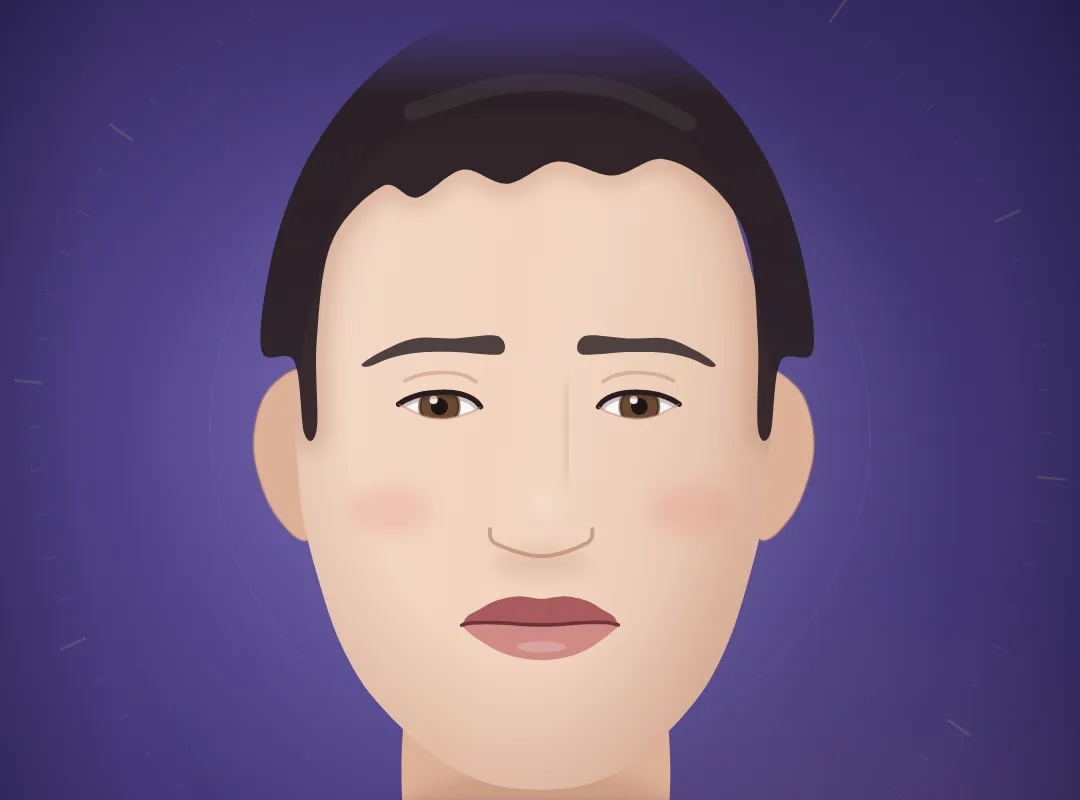
If people keep asking “are you okay?” when you feel fine, your resting face probably carries a faint trace of an expression: inner brows that sit low, upper eyelids that hang a little, or mouth corners that turn slightly down. Other people read those traces as anger, tiredness or sadness in a fraction of a second, even though nothing is wrong.
Psychologists call this emotion overgeneralization: we read real emotion into faces that only resemble it. Part of it is the structure you were born with, part is habit and part is plain lack of sleep. The last two you can change.
The short answer
| What people think they see | The usual cue | Can you change it? |
|---|---|---|
| Angry or annoyed | Inner brows lowered, frown lines between the brows | Partly: relax the brow, groom the inner brows |
| Tired | Upper eyelids hanging lower, outer brows dropping | Partly: sleep, light and camera angle |
| Sad | Mouth corners turned down, a tired face | Partly: sleep, a softer resting mouth |
| Unimpressed (“RBF”) | Slight tension around the eyes, a small pull at the lip corners | A little: notice and relax it |
Why a neutral face can look angry
Your brain reads faces fast. In a 2008 study in PNAS, Nikolaas Oosterhof and Alexander Todorov found that people's judgments of how trustworthy a neutral face looks track how happy or angry it looks. In their computer models, a face made to look less trustworthy also looked angrier, and one made to look more trustworthy looked happier.
A year later, Christopher Said, Nicu Sebe and Alexander Todorov (Emotion, 2009) ran emotionally neutral faces through software trained to detect expressions. Faces people rated positively slightly resembled happiness, faces rated negatively resembled disgust and fear, and faces rated as threatening resembled anger, even though nobody in the photos was making those expressions. The authors concluded that trait judgments partly come from overgeneralizing emotion recognition: a face that structurally looks a bit like an angry face gets treated a bit like one.
A 2012 study by Reginald Adams and colleagues (Cognition & Emotion) tested this directly. When the researchers digitally gave neutral faces features borrowed from angry or fearful expressions, impressions of those faces changed with them.
So a resting face that “looks mad” usually isn't a mood at all. It's geometry the brain mistakes for a mood. Our post on first impressions covers how fast these judgments form, about a tenth of a second.
What “resting bitch face” actually is
The internet calls the unimpressed version resting bitch face (RBF). In 2015, two behavioral researchers working with Noldus Information Technology, Jason Rogers and Abbe Macbeth, ran faces through the company's FaceReader software, which maps more than 500 points on the face to score expressions.
- Faces described as RBF showed small traces of contempt: about 6% of the expression, according to press reports of the analysis.
- The cues were tiny: a slight tightening around the eyes and a small pull at the corners of the lips.
- The faces weren't actually contemptuous. The researchers said the software wasn't detecting enough contempt to reflect a real feeling; the faces just look like it to a viewer.
- The effect showed up in men and women alike, even though women get the label far more often.
Keep it in proportion: this was a company analysis published through press coverage, not a peer-reviewed study. And software can read the shape of an expression, not what anyone actually feels.
Why you might look tired when you're not
Two kinds of research point to the same few features.
Eyelids and brows. In a 2008 study in Plastic and Reconstructive Surgery, Knoll, Attkiss and Persing digitally altered a photo of a young face and asked people to rate the expressions they saw.
- Tired: lowering the upper eyelid, changing the crease above it and lowering the outer brow made the face look more tired. Upper lid height mattered most.
- Angry: lowering the inner brow and adding frown lines between the brows made it look angry or disgusted.
- Shape over position: the shape of the brow mattered more than how high it sat.
- Happy: a slightly raised lower lid and crow's feet made the face look happier.
Sleep. In a 2013 study in Sleep, Tina Sundelin and colleagues photographed 10 people after a normal night and again after 31 hours awake. Observers rated the sleep-deprived faces as having more hanging eyelids, redder and more swollen eyes, darker circles under the eyes and droopier mouth corners. The faces also looked sadder.
A larger 2019 study by the same research group (181 people) found that the physical changes from sleep loss are subtle and hard to measure. But the cues people use to judge tiredness held up: less open eyes, a downturned mouth and darker skin around the eyes all made faces look more fatigued. So you can look tired without being tired, and you look more tired when you are. For more on this, see cortisol face vs. sleep.
Three reasons your resting face reads the way it does
- Structure. Some people simply have lower-set or straighter inner brows, heavier upper lids or a mouth line that turns down slightly at rest. None of this says anything about personality, but other people read it anyway.
- Habit. Many of us frown when we concentrate, squint at screens or tense the jaw. Repeated often enough, it becomes the face you wear by default.
- State and age. Short sleep makes lids hang and mouth corners drop, and with age the brows and the corners of the mouth tend to sit lower. Our post on how faces change with age explains why.
What actually helps
- Catch your concentration face. Check it in your phone's front camera while you read or type. If your brows are pulled together, relax your forehead. If you squint at screens, raise the brightness or text size, and get your eyes checked if you squint a lot.
- Find a softer resting expression. Lips gently closed, jaw loose and a tiny lift at the mouth corners. The Knoll study found that a slightly raised lower lid reads as happy, which is why a real smile shows in the eyes.
- Shape the inner brows. Since brow shape changes how a face reads, grooming that keeps the inner brows from looking heavy or pinched can soften a stern look. See eyebrow shapes for your face shape.
- Sleep. It is the one cue of tiredness that people reliably read, and the cheapest fix.
- Fix the photo, not the face. Shoot at eye level from about arm's length in soft light from the front. Overhead light deepens shadows under the brows and eyes. Then take several shots and let a friend pick.
- See a professional for a drooping eyelid. If an upper eyelid hangs low enough to block your vision, or one side droops more than before, see a doctor. For cosmetic changes such as brow or lid procedures, talk to a qualified professional, never an unregulated provider.
Test your own resting face
You can't judge your own resting face well, because you know what you're feeling. A blind test with other people is quick and more honest:
- Take three photos in the same soft front light, phone at eye level about 1.5 m away with a timer:
- A: your normal resting face, as you'd sit on a train.
- B: your "concentration" face. Read something on a screen for a minute, then take the photo without changing your face.
- C: the softer resting face from tip 2 above: lips gently closed, jaw loose, a tiny lift at the mouth corners.
- Show them in a random order to at least five people, without saying what each one is, and ask for one word that describes how the person looks.
- Count the words. If "tired", "annoyed", "sad" or "bored" come up for A or B but not for C, the cue is habit, and you've just shown yourself the fix. If C still gets them, look at structure and sleep: brow shape (tip 3), eyelid height and dark circles are the cues the studies above found.
One caution: with five people, two or three negative words for one photo can easily happen by chance. Look for a clear pattern, like four or five of five.
Can an AI tell if you look angry?
No app can read your mood from a still photo. The free AI face analysis measures structure, such as eye tilt, symmetry and proportions, not emotion. Expression-reading software like FaceReader only scores the shape of an expression, which is exactly why it "found" contempt in faces that weren't feeling any.
Remember what the research really shows: these are first impressions of a face at rest, made in a moment and often wrong. They change the second you start talking.
FAQ
Is resting bitch face real?
The look is real in the sense that some neutral faces carry small traces of expressions, and people read them as emotion. The best-known analysis, by researchers working with the software company Noldus, found small traces of contempt in “RBF” faces, though the researchers said the faces weren't really showing contempt. It wasn't a peer-reviewed study.
Why do I look angry when I'm not?
Usually because your inner brows sit low or are pulled together, or you have frown lines between them. Studies show people read those features as anger even on a completely neutral face, a mistake called emotion overgeneralization.
Why do I always look tired?
Upper eyelids that hang a little lower, outer brows that dip and dark circles under the eyes are the strongest tiredness cues. Some faces have them by nature. Sleep loss makes all of them more visible, and it makes faces look sadder as well.
Can you fix a resting face?
Partly. Relaxing your brow when you concentrate, sleeping enough, grooming your brows and taking photos in soft light at eye level all change how your face reads. Bone and lid structure don't change, but first impressions shift quickly once people see you talk and react.
Do men get resting bitch face too?
Yes. The Noldus analysis reported the same effect in men and women, even though women are labeled with it far more often.
Sources
- Oosterhof NN, Todorov A (2008). The functional basis of face evaluation. Proceedings of the National Academy of Sciences 105(32):11087–11092.
- Said CP, Sebe N, Todorov A (2009). Structural resemblance to emotional expressions predicts evaluation of emotionally neutral faces. Emotion 9(2):260–264.
- Adams RB, Nelson AJ, Soto JA, Hess U, Kleck RE (2012). Emotion in the neutral face: a mechanism for impression formation?. Cognition & Emotion 26(3):431–441.
- Rogers J, Macbeth A (2015). Throwing shade: the science of resting bitch face. Noldus Information Technology (company report, via CBS News).
- Knoll BI, Attkiss KJ, Persing JA (2008). The influence of forehead, brow, and periorbital aesthetics on perceived expression in the youthful face. Plastic and Reconstructive Surgery 121(5):1793–1802.
- Sundelin T, et al. (2013). Cues of fatigue: effects of sleep deprivation on facial appearance. Sleep 36(9):1355–1360.
- Holding BC, Sundelin T, et al. (2019). The effect of sleep deprivation on objective and subjective measures of facial appearance. Journal of Sleep Research.